
Economy
Naira May Remain Under Pressure in 2026—Yemi Kale

By Adedapo Adesanya
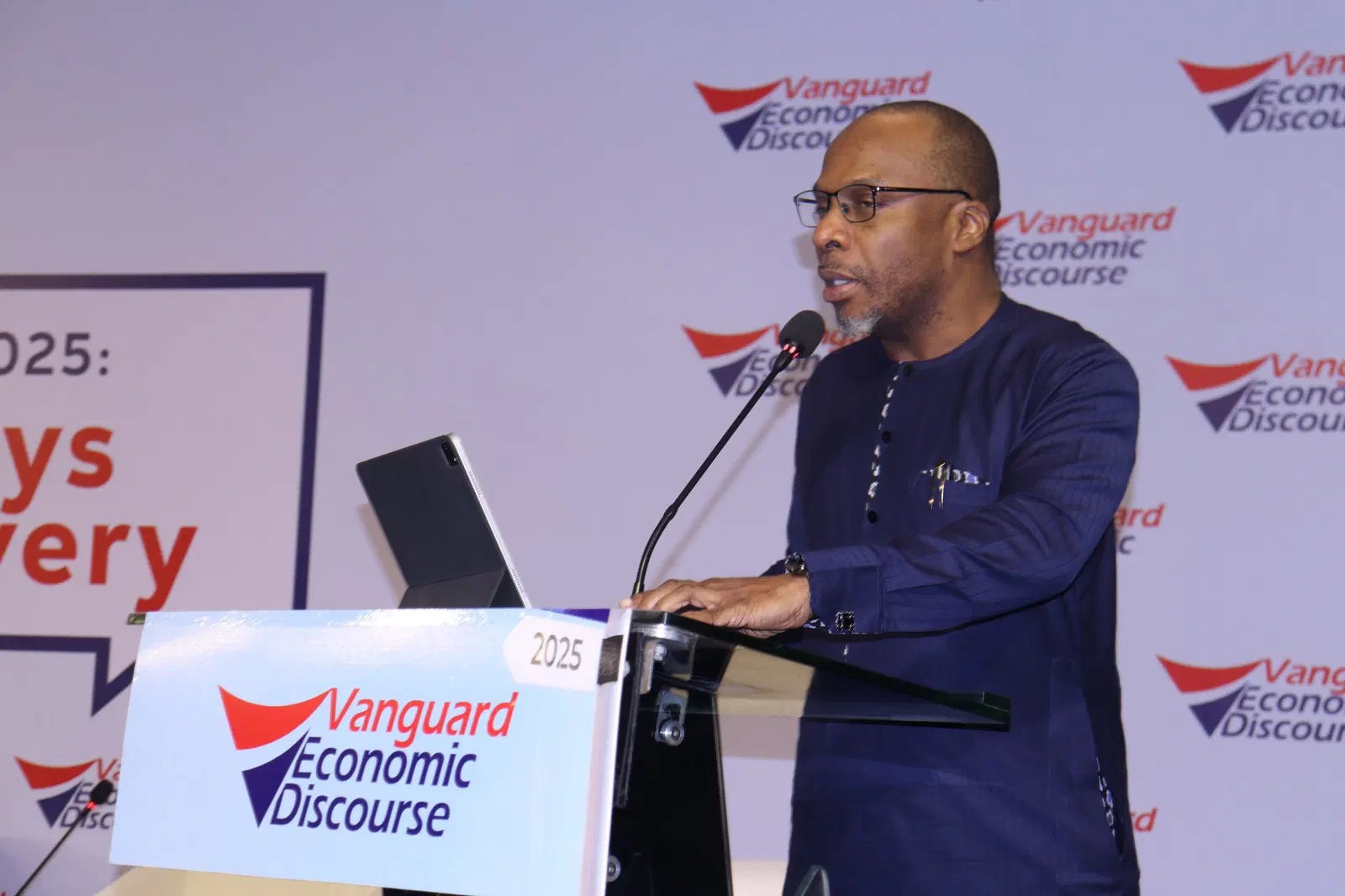
Top economist, Mr Yemi Kale, has projected that the Naira will remain under pressure against the United States Dollar in 2026, due to some external pressures.
Mr Kale, who is currently the Senior Economist at Africa Export-Import Bank (Afreximbank) and formerly the Statistician-General of Nigeria, made the disclosure while delivering his keynote speech at the FirstBank Nigeria Economic Outlook 2026.
He outlines three scenario-based forecasts for the Dollar/Naira exchange rate, reflecting varying assumptions around oil prices, foreign-exchange (FX) inflows, inflation trends, and policy consistency.
Under the baseline scenario, the Naira is projected to trade around N1,350/$1–N1,450/$1 by the end of 2026.
According to the outlook, key assumptions include moderate improvement in Nigeria’s FX reserves and oil export revenues, relative stability in FX policy by the Central Bank of Nigeria (CBN), gradual decline in inflation, and the absence of major external shocks, such as a sharp oil price collapse or a global Dollar surge.
It is projected that by June 2026, Naira will trade at approximately N1,313 to the Dollar, and around N1,340/$1 by December 2026.
The outlook notes that currency risks remain elevated, justifying a cautious baseline forecast rather than expectations of strong appreciation.
It noted that the Naira would remain under pressure but avoid a sharp collapse, pointing to moderate depreciation or a mild recovery from weaker levels.
In a more positive outlook, the Naira could strengthen to between N1,200 and N1,300 per Dollar by the end of 2026.
Key assumptions include strong oil price recovery or successful export diversification, effective FX reforms by the CBN, improved liquidity, and narrower gaps between official and parallel markets, and significant decline in inflation, restoring investor confidence.
He noted that this could be buoyed by increased FX inflows from oil, gas, remittances, and non-oil exports
A weaker global US Dollar, which would support emerging-market currencies.
According to the outlook, even at N1,200, the Naira would remain significantly weaker than historical benchmarks, underscoring persistent structural challenges.
In the worst-case scenario projects the Naira could weaken to N1,550–N1,650 or beyond by the end of 2026.
Key assumptions are weak oil prices or production disruptions reducing FX inflows, deepening FX liquidity crisis and forced currency devaluation, and rising inflation, widening fiscal deficits, and erosion of investor confidence
While extreme, the scenario remains plausible given Nigeria’s structural vulnerabilities, including import dependence, FX mismatches, and inflationary pressures.
The outlook projects a gradual rebuild of Nigeria’s external reserves toward $45 billion by 2027, driven by higher remittance inflows, improved oil receipts, and portfolio investment re-entries.
He noted that policy consistency, particularly transparent FX management and fiscal discipline, is critical to sustaining investor confidence and strengthening Nigeria’s balance-of-payments position.
He added that local refining capacity could also help reduce reliance on petroleum imports, save billions of Dollars in FX annually, while export growth in agriculture, manufacturing, and services under the AfCFTA is expanding Nigeria’s non-oil FX base.












By Aduragbemi Omiyale
Over 200 secondary school students from Covenant Child Academy, Testimony College, and Green Pastures High School were recently introduced to the fundamentals of financial literacy, capital markets, and responsible investing, offering early exposure to wealth-building principles by the Nigerian Exchange (NGX) Limited.
It was part of Customs Street’s week-long programme to commemorate Global Money Week 2026, themed Smart Money Talks.
The bourse joined the global community to celebrate the week as part of its commitment to advancing financial literacy and equipping the next generation of investors.
The students, who underwent the seminar under the NGX’s flagship X-Tour initiative, were guided by representatives from NGX and NGX Regulation on key considerations before investing, as well as common warning signs to watch for when evaluating investment opportunities.
The session reinforced the importance of cultivating positive money habits to support sound financial decisions in the future.
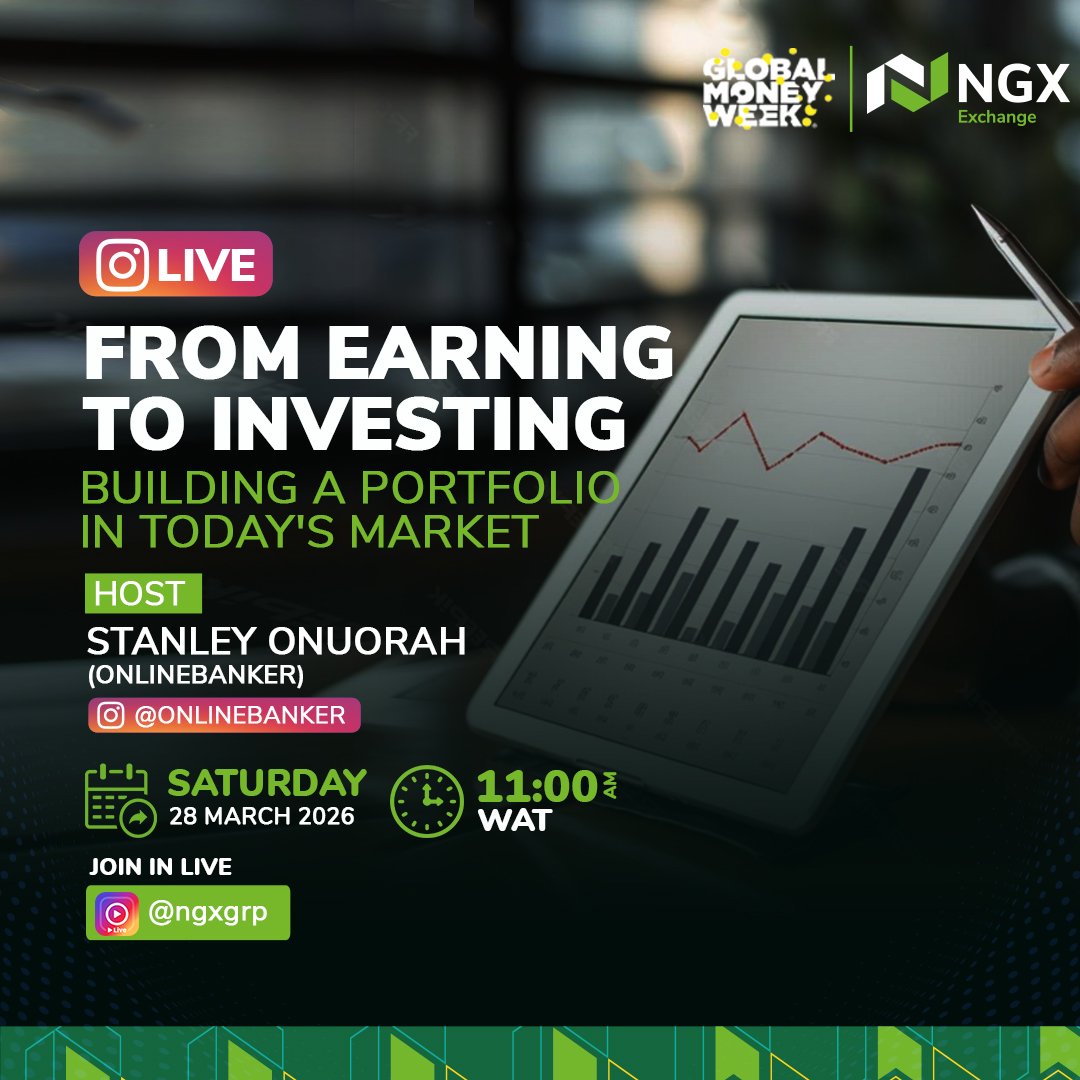
Extending its impact beyond in-person engagement, the exchange also convened an interactive Instagram Live session in collaboration with United Capital Plc.
Featuring Stanley Onuorah, widely known as Online Banker, the session focused on Building a Portfolio in Today’s Markets. It addressed pressing questions from young Nigerians on navigating the capital market, understanding available investment products, and making informed financial choices.
During the session, a representative from NGX’s Trading and Products division shared practical insights into the range of instruments available in the market, including equities, fixed income securities, and exchange-traded funds, while outlining clear pathways for getting started and building resilient portfolios across varying market conditions.
In parallel, a representative from Market Regulation emphasised the importance of investor protection frameworks, educating participants on their rights, the safeguards that ensure fair market practices, and the necessity of due diligence in sustaining trust and integrity within the market.
The session has since attracted thousands of views, significantly amplifying awareness around financial literacy and encouraging greater youth participation in the capital market.
Through these initiatives, NGX continues to play a pivotal role in shaping financially responsible citizens, in line with its broader mandate to drive inclusive growth and strengthen investor confidence within Nigeria’s financial ecosystem.

By Adedapo Adesanya
The NASD Over-the-Counter (OTC) Securities Exchange declined by 2.14 per cent on Monday, March 30, weakening the Unlisted Security Index (NSI) by 89.95 points to 4,109.74 points from 4,199.69 points.
During the session, investors lost N53.82 billion, leaving the market capitalisation of the trading platform at N2.458 trillion versus the previous session’s N2.512 trillion.
The bourse recorded four price gainers and four price losers led by 11 Plc, which shed N35.12 to close at N316.50 per share compared with last Friday’s value of N351.17 per share. MRS Oil Plc declined by N20.00 to quote at N190.00 per unit versus the previous price of N21o.00 per unit, FrieslandCampina Wamco Nigeria Plc dropped N11.00 to trade at N99.00 per share versus N110.00 per share, and Central Securities Clearing System (CSCS) Plc dipped N2.93 to N77.17 per unit from N80.10 per unit.
Conversely, IPWA Plc appreciated by 55 Kobo to N6.06 per share from N5.51 per share, Industrial and General Insurance (IGI) Plc expanded by 5 Kobo to 57 Kobo per unit from 52 Kobo per unit, Geo-Fluids Plc gained 4 Kobo to close at N3.22 per share versus N3.18 per share, and Acorn Petroleum Plc improved by 1 Kobo to N1.34 per unit from N1.33 per unit.
Trading data revealed a decline of 63.7 per cent in the volume of securities to 21.3 million units from 58.6 million units, a 59.6 per cent drop in the value of securities to N651.1 million from N1.6 billion, and a 24 per cent contraction in the number of deals to 38 deals from 50 deals.
The most active stock by value on a year-to-date basis was CSCS Plc with 56.3 million units exchanged for N3.8 billion, trailed by Okitipupa Plc with 27.5 million units traded for N1.8 billion, and Infrastructure Guarantee Credit Plc with 400 million units valued at N1.2 billion.
Resourcery Plc was the most traded stock by volume on a year-to-date basis with 1.1 billion units worth N415.7 million, followed by Infrastructure Guarantee Credit Plc with 400 million units sold for N1.2 billion, and Geo-Fluids Plc with 133.1 million units transacted for N511.2 million.

By Dipo Olowookere
The Nigerian Exchange (NGX) Limited began the new week bearish after it shed 0.21 per cent on Monday due to profit-taking.
Business Post reports that four of the five key sectors of Customs Street tracked pointed southwards yesterday, as only the energy index gained 0.10 per cent.
The insurance counter lost 1.38 per cent, the banking space depreciated by 0.81 per cent, the industrial goods sector weakened by 0.45 per cent, and the consumer goods segment declined by 0.02 per cent.
As a result, the All-Share Index (ASI) retreated by 428.63 points to 200,484.43 points from 200,913.06 points, and the market capitalisation moderated by N275 billion to N128.694 trillion from N128.969 trillion.
The market breadth index was negative during the session, as there were 27 price gainers and 34 price losers, representing weak investor sentiment.
Secure Electronic Technology depreciated by 10.00 per cent to N1.17, May and Baker slumped by 9.42 per cent to N38.00, Legend Internet tumbled by 8.67 per cent to N6.85, Cutix shrank by 8.29 per cent to N3.21, and Fortis Global Insurance lost 7.97 per cent to trade at N1.27.
On the flip side, Austin Laz appreciated by 9.98 per cent to N4.41, Zichis gained 9.93 per cent to quote at N15.16, Trans Nationwide Express soared by 9.65 per cent to N2.84, The Initiates advanced by 9.60 per cent to N21.70, and Learn Africa improved by 9.41 per cent to N9.30.
The bourse closed with a turnover of 593.3 million shares valued at N25.7 billion executed in 60,311 deals compared with the 595.2 million shares worth N24.5 billion traded in 43,440 deals in the previous trading day.
This showed that the value of transactions went up by 4.90 per cent, the number of deals increased by 38.84 per cent, and the volume of trades decreased by 0.32 per cent.
Access Holdings finished the session as the most active with 86.6 million units sold for N2.3 billion, First Holdco exchanged 84.6 million units worth N4.3 billion, Secure Electronic Technology traded 31.1 million units valued at N37.4 million, Fidelity Bank transacted 26.7 million units worth N512.4 million, and Zenith Bank traded 26.1 million units valued at N2.6 billion.











-
 Feature/OPED6 years ago
Davos was Different this year
-
Travel/Tourism10 years ago
Lagos Seals Western Lodge Hotel In Ikorodu
-

 Showbiz3 years ago
Estranged Lover Releases Videos of Empress Njamah Bathing
-
 Banking8 years ago
Sort Codes of GTBank Branches in Nigeria
-

 Economy3 years ago
Subsidy Removal: CNG at N130 Per Litre Cheaper Than Petrol—IPMAN
-

 Banking3 years ago
Sort Codes of UBA Branches in Nigeria
-

 Banking3 years ago
First Bank Announces Planned Downtime
-

 Sports3 years ago
Highest Paid Nigerian Footballer – How Much Do Nigerian Footballers Earn
Pingback: Vanguard Economic Discourse 2026: Nigerian...