Connect with us

Economy

US Stocks Open Higher on Possible Trade Talks

Published

on

US Stocks report

By Investors Hub

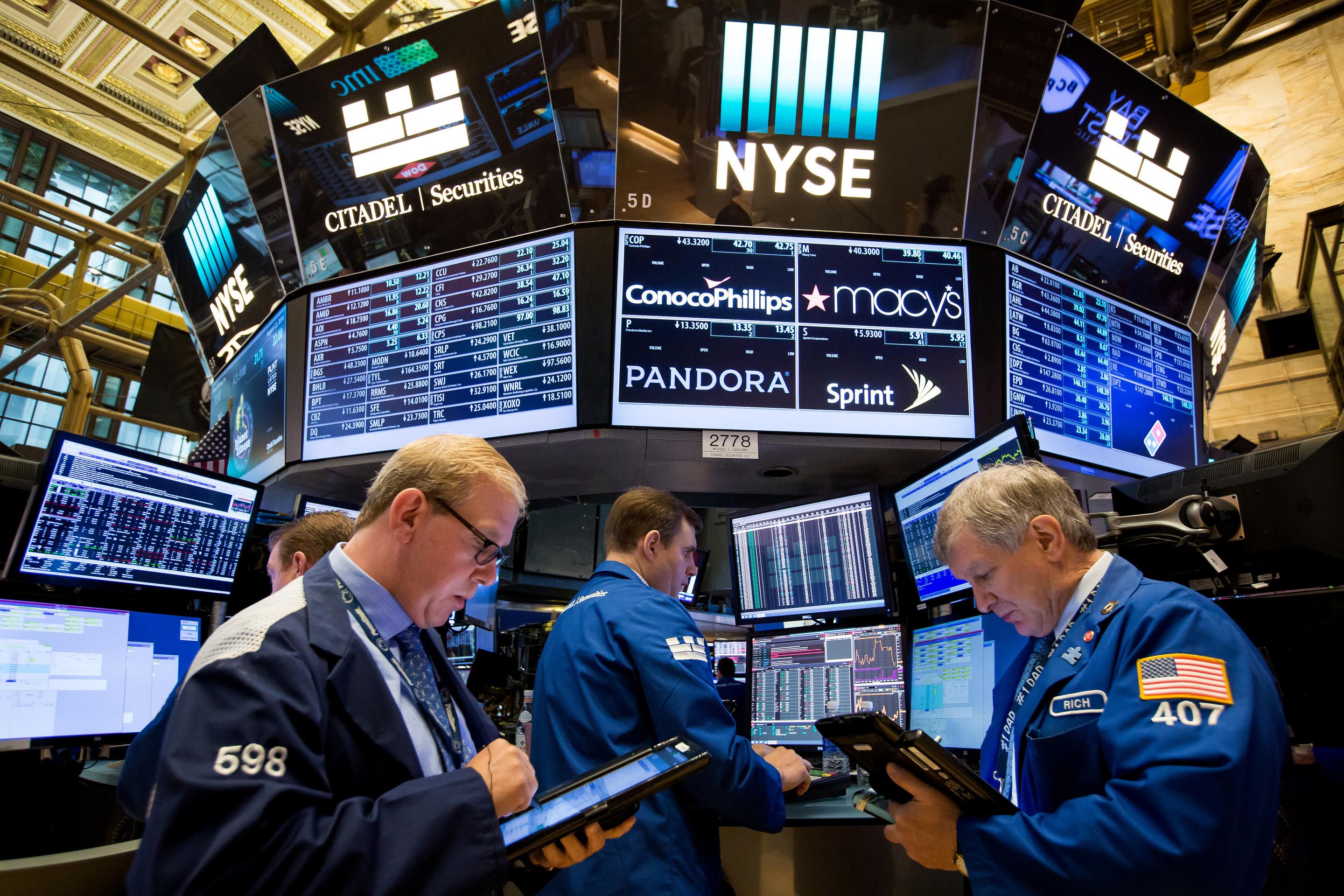
The major U.S. index futures are currently pointing to a higher opening on Friday, as traders express continued optimism about a potential de-escalation of the U.S.-China trade war.

The upward momentum on Wall Street comes as traders cling to hopes the U.S. and China will resume trade talks next month and finally reach an elusive trade deal.

President Donald Trump has repeatedly claimed the Chinese are desperate to reach an agreement, arguing the U.S. tariffs on Chinese goods are doing significant damage to the world?s second largest economy.

Trump told Fox News on Thursday that the U.S. and China were scheduled to hold talks at a ?different level,? although he did not clarify what that means.

Meanwhile, China has signaled that they do not currently intend to retaliate against Trump?s latest threat to raise the rate of tariffs on Chinese imports.

Chinese officials have expressed interest in negotiating an end to the escalating trade dispute but argued the U.S. has to create conditions for the two sides to resume talks on the basis of mutual respect.

After moving sharply higher early in the session, stocks saw some further upside over the course of the trading day on Thursday. The major averages managed to remain firmly positive after reversing direction from their initial moves in each of the two previous sessions.

The major averages pulled back off their best levels in late-day trading but held on to strong gains. The Dow surged up 326.15 points or 1.3 percent to 26,362.25, the Nasdaq soared 116.51 points or 1.5 percent to 7,973.39 and the S&P 500 jumped 36.64 points or 1.3 percent at 2,924.58.

The initial strength on Wall Street came on the heels of indications China is seeking to de-escalate the trade war with the U.S.

Chinese Ministry of Commerce spokesman Gao Feng indicated China does not currently intend to retaliate against President Donald Trump’s latest threat to raise the rate of tariffs on Chinese imports.

“We firmly reject an escalation of the trade war, and are willing to negotiate and collaborate in order to solve this problem with calm attitude,” Gao said, according to a CNBC translation.

Gao claimed China has plenty of countermeasures it could impose but will instead focus on removing Trump’s new tariffs, which were announced after China said it plans to impose tariffs on $75 billion worth of U.S. goods.

“The most important thing at the moment is to create necessary conditions for both sides to continue negotiations,” Gao told reporters during a weekly briefing.

On the U.S. economic front, the Labor Department released a report showing a modest increase in first-time claims for U.S. unemployment benefits in the week ended August 24th.

The report said initial jobless claims inched up to 215,000, an increase of 4,000 from the previous week’s revised level of 211,000.

Economists had expected jobless claims to climb to 215,000 from the 209,000 originally reported for the previous week.

A separate report released by the Commerce Department showed the pace of growth in U.S. economic activity slowed by slightly more than initially estimated in the second quarter.

The Commerce Department said gross domestic product increased by 2.0 percent in the second quarter compared to the previously reported 2.1 percent growth. The downward revision came in line with economist estimates.

The downwardly revised GDP growth seen in the second quarter compares to the 3.1 percent jump in GDP reported for the first quarter.

Meanwhile, the National Association of Realtors also released a report showing a sharp pullback in pending home sales in the month of July.

NAR said its pending home sales index tumbled by 2.5 percent to 105.6 in July after surging up by 2.8 percent to 108.3 in June. The steep drop came as a surprise to economists, who had expected pending sales to come in unchanged.

A pending home sale is one in which a contract was signed but not yet closed. Normally, it takes four to six weeks to close a contracted sale.

Reflecting the optimism about a potential de-escalation of the U.S.-China trade war, steel stocks showed a significant move to the upside on the day.

The NYSE Arca Steel Index surged up by 2.4 percent, climbing further off the nearly three-year closing low set on Tuesday.

Significant strength was also visible among natural gas stocks, as reflected by the 2.6 percent jump by the NYSE Arca Natural Gas Index. The strength in the sector came as natural gas for October delivery climbed $0.067 to $2.289 per million BTUs.

Computer hardware, semiconductor, and transportation stocks also saw considerable strength on the day, moving higher along with most of the other major sectors.

Meanwhile, gold stocks were among the few groups to buck the uptrend, dragging the NYSE Arca Gold Bugs Index down by 3.2 percent. The index ended the previous session at a nearly three-year closing high.


Modupe Gbadeyanka is a fast-rising journalist with Business Post Nigeria. Her passion for journalism is amazing. She is willing to learn more with a view to becoming one of the best pen-pushers in Nigeria. Her role models are the duo of CNN's Richard Quest and Christiane Amanpour.

Click to comment

Leave a Reply

Your email address will not be published. Required fields are marked *

Economy

Four Securities Erase N51.17bn from NASD Exchange

Published

on

NASD Exchange

By Adedapo Adesanya

Four securities weakened the NASD Over-the-Counter (OTC) Securities Exchange by 1.95 per cent on Friday, erasing N41.17 billion from the bourse, which had its market capitalisation at N2.567 trillion compared with the previous session’s N2.618 trillion.

In the same vein, the NASD Unlisted Security Index (NSI) decreased at the close of business by 85.28 points to 4,277.07 points from 4,362.32 points.

The price decliners were led by 11 Plc, which gave up N20.50 to sell at N200.50 per share compared with the preceding day’s N221.00 per share, FrieslandCampina Wamco Nigeria Plc dropped N16.94 to close at N155.20 per unit versus Thursday’s closing price of N172.14 per unit, Central Securities Clearing System (CSCS) Plc went down by N2.11 to N84.68 per share from N86.79 per share, and Afriland Properties Plc lost 11 Kobo to end at N16.74 per unit, in contrast to the N16.85 per unit it closed a day earlier.

During the trading day, the value of transactions jumped by 172.1 per cent to N29.9 million from the preceding session’s N10.9 million, and the volume of trades soared by 136.5 per cent to 955,096 units from the previous 403,901 units, while the number of deals went down by 11.4 per cent to 31 deals from 35 deals.

Great Nigeria Insurance (GNI) Plc remained the most active stock by value on a year-to-date basis, with 3.4 billion units valued at N8.4 billion, followed by Infrastructure Credit Guarantee (Infracredit) Plc with 2.3 billion units worth N6.5 billion, and CSCS Plc with 68.6 million units sold for N4.7 billion.

GNI Plc also ended the session as the most traded stock by volume on a year-to-date basis, with 3.4 billion units exchanged for N8.4 billion, trailed by Infracredit Plc with 2.3 billion units traded for N6.5 billion, and Resourcery Plc with 1.1 billion units transacted for N415.7 million.

Continue Reading

Economy

Cautious Trading, Profit-taking Weaken Nigeria’s Stock Exchange by 0.66%

Published

on

Nigeria's stock exchange

By Dipo Olowookere

The last trading session of this week on the floor of the Nigerian Exchange (NGX) Limited ended on a negative note, with a 0.66 per cent loss on Friday.

This was influenced by sustained selling pressure and cautious trading, which forced investors into profit-taking.

Data obtained by Business Post showed that the energy sector fell by 4.66 per cent, the insurance counter dipped by 2.23 per cent, the consumer goods index depreciated by 0.96 per cent, and the banking segment shed 0.28 per cent, while the industrial goods space remained unchanged.

At the close of business, the All-Share Index (ASI) of Nigeria’s stock exchange went down by 1,531.81 points to 232,049.02 points from 233,580.83 points, and the market capitalisation dropped N983 billion to settle at N148.905 trillion compared with Thursday’s N149.888 trillion.

Aradel was the worst-performing equity after it lost 10.00 per cent to close at N1,417.50. International Energy Insurance slipped by 9.95 per cent to N5.79, Trans-Nationwide Express depreciated by 9.89 per cent to N3.28, eTranzact crashed by 9.79 per cent to N14.75, and UPDC slumped by 9.72 per cent to N28.12.

The best-performing equity for the day was Universal Insurance, which gained 6.32 per cent to close at N1.01, McNichols grew by 5.52 per cent to N8.60, Linkage Assurance expanded by 4.67 per cent to N1.57, NGX Group appreciated by 4.35 per cent to N120.00, and Transcorp increased by 3.62 per cent to N41.50.

As look at the activity level indicated that investors traded 388.7 million stocks worth N18.4 billion in 44,631 deals compared with the 393.7 million stocks valued at N19.2 billion executed in 45,813 deals a day earlier, representing a decline in the trading volume, value, and number of deals by 1.27 per cent, 4.17 per cent, and 2.58 per cent, respectively.

Continue Reading

Economy

Official FX Market Sees Naira Dip to N1,380.93/$1

Published

on

naira official market

By Adedapo Adesanya

The Naira recorded a loss of 82 Kobo or 0.06 per cent against the United States Dollar in the Nigerian Autonomous Foreign Exchange Market (NAFEX) on Friday, June 26, exchanging at N1,380.93/$1, in contrast to the previous day’s rate of N1,380.11/$1.

Equally, the domestic currency further weakened against the Pound Sterling in the official FX market yesterday by N6.06 to settle at N1,824.90/£1 versus the preceding session’s N1,818.84/£1, and lost N10.74 on the Euro to sell at N1,577 .58/€1 versus N1,566.84/€1.

At the GTBank forex counter, the Naira depreciated against the greenback during the session by N4 to close at N1,387/$1, in contrast to Thursday’s value of N1,383/$1, and at the parallel market, it was unchanged at N1,395/$1.

Interbank FX activity among financial institutions has fluctuated amid a sharp slowdown in forex market interventions by the Central Bank of Nigeria (CBN), as it allows demand and supply to move the market.

Also, a stronger greenback has generally put significant pressure on emerging-market currencies.

Nigeria has accessed the first tranche of a proposed $5 billion derivatives financing arrangement with First Abu Dhabi Bank PJSC, the largest lender in the United Arab Emirates (UAE).

The $5 billion facility, approved by the National Assembly earlier this year, is part of the federal government’s plan to diversify external financing sources and reduce borrowing costs. Structured as a Total Return Swap with First Abu Dhabi Bank, proceeds are earmarked for refinancing debt and supporting infrastructure financing.

If the proceeds are brought into the country through the official FX market, the transaction will increase the currency reserves or Dollar liquidity.

At the cryptocurrency market, Solana (SOL) grew by 2.2 per cent to $71.92, Cardano (ADA) gained 1.1 per cent to trade at $0.1474, Ripple (XRP) also appreciated by 1.1 per cent to $1.05, Dogecoin (DOGE) expanded by 0.9 per cent to $0.0755, and Ethereum (ETH) improved by 0.4 per cent to $1,578.84.

On the flip side, TRON (TRX) slid 0.6 per cent to $0.3203, Binance Coin (BNB) slumped by 0.3 per cent to $564.33, and Bitcoin fell by 0.2 per cent to $60,219.37, while the US Dollar Tether (USDT) and the US Dollar Coin (USDC) traded flat at $1.00 each.

Continue Reading

Trending