Economy
We Intend to Stop Borrowing to Fund Our Budgets—FG
By Ashemiriogwa Emmanuel
The Federal Government of Nigeria has said that it was looking towards a period when it would no longer require borrowing from both local and international sources to fund the nation’s budgets.
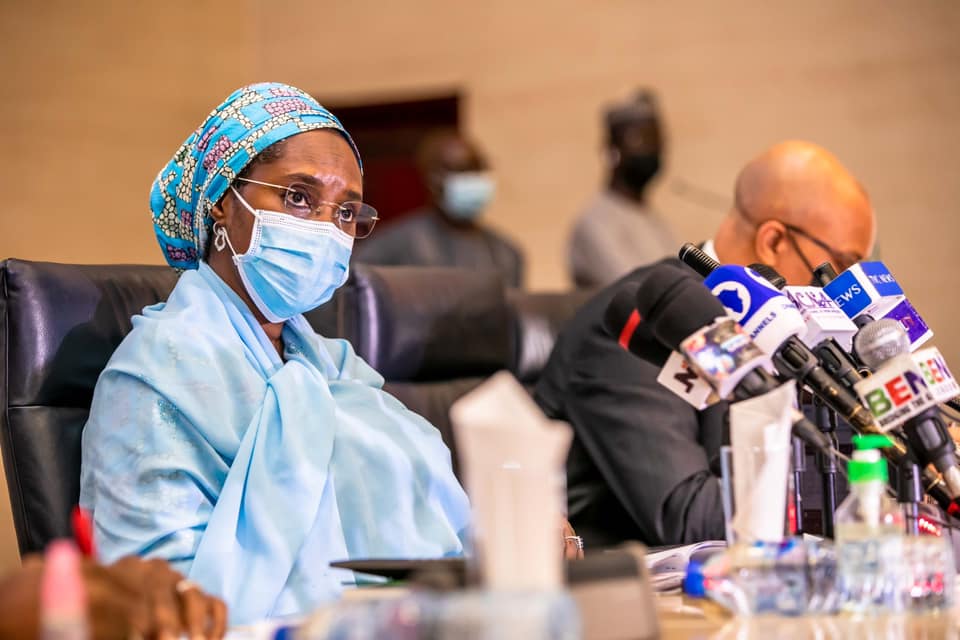
The Minister of Finance, Budget and National Planning, Mrs Zainab Ahmed, said this last Friday when she presented a breakdown of the 2022 budget proposal submitted to the National Assembly a day earlier by President Muhammadu Buhari.
Mr Buhari had last Thursday asked the parliament to approve N16.39 trillion to run the country next year with over N6 trillion deficit, which many analysts said was too much.
But Mrs Ahmed said at the moment, Nigeria has no other option than to borrow to finance the budget because revenues generated by the government are not enough to cover all the expenditures.
However, she noted that the government intends to run a balanced budget, where the nation would have enough or more earnings to meet the various expenditures, which means the government would have to stop borrowing to fund the budgets.
In her view, this is what the government wants to achieve in the medium to long-term but stressed that it is not a feat that can be achieved overnight.
The Minister said the global health crisis caused by COVID-19 forced many governments, including Nigeria, to resort to borrowing to finance budgets.
“Germany used to run a balanced budget but during the COVID-19, they had to also resort to borrowing.
“Borrowing, in itself, is not a bad thing to do as long as you are making sure you are borrowing on a sustainable basis and applying the funds to expenditure items that are very important and that would, themselves, yield good returns,” Mrs Ahmed said at the event attended by Business Post.
But she emphasised that balanced budgeting is an achievable goal, though not necessarily through cutting down on the government’s expenditures.
“Yes, it is an option, but you also have to know that it is not something that we can do overnight and it is not easy.
“It means disengaging people from work, and the President has consistently said ‘make sure you pay salaries, pensions’ because we don’t want to create more crisis within the polity,” Mrs Ahmed stated.
According to her, while reducing the cost of government is on the table, there is a process going on that is reviewing the total size of government as led by a special committee to critically look into this alternative.
Economy
Naira Rallies N7.27 on Dollar to N1,372/$1 at NAFEM
By Adedapo Adesanya
The Naira further appreciated against the US Dollar by N7.27 or 0.39 per cent to N1,372.41/41 in the Nigerian Autonomous Foreign Exchange Market (NAFEX) on Wednesday, July 1 compared with the previous day’s N1,379.68/$1.
The local currency also further improved against the Pound Sterling in the official market by N3.32 to close at N1,821.73/£1 compared N1,825.05/£1, and gained N7.61 on the Euro to sell at N1,565.37/€1 versus N1,572.98/€1.
Meanwhile, the Naira traded flat against the Dollar at the parallel market yesterday at N1,395/$1, and also closed flat at the GTBank FX desk at N1,389/$1.
Interbank FX deals count reduced to 91 from 166, reducing pressures on foreign currency supply at the FX window. A lower number of deals and turnover suggested that bank customers’ Dollar requests eased today, pointing to low demand and alleviating pressure on the Naira.
Nigeria’s gross external reserves closed the first half of 2026 at $51.46 billion following a sequence of additional FX inflows from across key sources, including oil sales.
The market also got affirmations of stronger policy direction as the Central Bank of Nigeria (CBN) continued to sanitise the financial system with the revocation of 46 microfinance banks across the country with immediate effect.
In the cryptocurrency market, the market was positive after the US Federal Reserve Chairman, Mr Kevin Warsh, said inflation risks had eased, giving a market that spent most of June grinding lower its first clear lift in weeks.
Speaking at the European Central Bank’s annual forum in Sintra, Portugal, on Wednesday, Mr Warsh said “inflation risks have come down” while reaffirming the Fed’s commitment to returning inflation to 2 per cent.
Solana (SOL) grew by 3.9 per cent to $78.02, Bitcoin (BTC) rose by 2.5 per cent to $60,385.27, Ethereum (ETH) expanded by 2.3 per cent to $1,623.09, Cardano (ADA) jumped by 2.1 per cent to $0.1542, Ripple (XRP) appreciated by 0.9 per cent to $1.05, Dogecoin (DOGE) increased by 0.7 per cent to $0.0726, and Binance Coin (BNB) soared by 0.4 per cent to $551.50.
On the flip side, TRON (TRX) fell by 0.2 per cent to $0.3154, while the US Dollar Tether (USDT) and the US Dollar Coin (USDC) remained unchanged at $1.00 each.
Economy
Aradel, Dangote Cement, Others Pull Back Stock Exchange by 1.65%
By Dipo Olowookere
The gains recorded by the Nigerian Exchange (NGX) Limited on Tuesday were quickly erased on Wednesday after stocks like Dangote Cement, Aradel Holdings, International Breweries and others recorded losses.
Apart from the insurance index, which closed higher by 0.42 per cent, every other sector ended in the red, with the energy space down by 4.41 per cent. The industrial goods segment lost 3.63 per cent, the banking sector depreciated by 1.49 per cent, and the consumer goods counter fell by 0.93 per cent.
Consequently, the All-Share Index (ASI) contracted by 3,729.11 points to 225,690.07 points from 229,419.18 points, and the market capitalisation retreated by N2.393 trillion to N144.825 trillion from N147.218 trillion.
Investor sentiment was bearish after the stock exchange closed the day with 22 appreciating equities and 32 depreciating equities, indicating a negative market breadth index.
Neimeth shed 10.00 per cent to settle at N8.10, Aradel bled by 10.00 per cent to quote at N1,275.80, NASCON crashed by 9.98 per cent to N197.60, International Breweries lost 9.52 per cent to trade at N9.50, and Livestock Feeds slipped by 9.43 per cent to N28.12.
On the flip side, Austin Laz gained 10.00 per cent to sell for N3.30, Guinea Insurance appreciated by 9.89 per cent to N1.00, DAAR Communications rose by 9.60 per cent to N1.37, Regency Alliance expanded by 9.52 per cent to 92 Kobo, and Sovereign Trust Insurance grew by 7.85 per cent to N2.06.
Business Post reports that the level of activity dropped yesterday, and Sterling Holdings led the activity log, with a turnover of 124.6 million units worth N980.6 million. UPDC traded 40.1 million units for N130.4 million, Access Holdings exchanged 36.8 million units valued at N811.6 million, Honeywell Flour transacted 33.8 million units worth N490.1 million, and United Capital sold 28.4 million units for N469.1 million.
At the close of transactions, market participants traded 488.1 million units valued at N14.0 billion in 46,929 deals versus the 966.7 million units worth N40.0 billion executed in 49,579 deals in the previous session, implying a drop in the trading volume, value, and number of deals by 49.51 per cent, 65.00 per cent, and 5.35 per cent, respectively.
Economy
Crude Oil Drops Nearly 2% as Trump Hails Iran Talks
By Adedapo Adesanya
Crude oil was down by nearly 2 per cent on Wednesday as optimism over US-Iran talks eased supply concerns after US President Donald Trump said discussions in Qatar had gone well.
Brent futures gave up $1.38 or 1.89 per cent to sell for $71.57 a barrel, and the US West Texas Intermediate (WTI) crude lost 92 cents or 1.32 per cent to trade at $68.58 a barrel.
President Trump said on Wednesday that the US was getting along very well with Iran and that recent meetings in Qatar went well.
“The denuclearisation of Iran is moving along well,” the American President told reporters. “They’ve had very good meetings, and we’ll see.”
The US and Iran held technical talks in Doha as they seek to agree on the flow of shipping through the Strait of Hormuz and secure a lasting ceasefire, a source with direct knowledge of the talks and an Iranian official said.
The US and Iran have sparred publicly over the meaning of the interim pact, exchanging military strikes over the past week.
Meanwhile, US Vice President JD Vance again signalled that the White House is prepared to use force against Iran if diplomacy fails, raising the stakes around a 60-day memorandum of understanding (MOU) that has halted open hostilities but left the core disputes unresolved.
Crude oil inventories in the United States decreased by 3.8 million barrels during the week ending June 26, according to new data from the U.S. Energy Information Administration (EIA) released on Wednesday. The EIA’s data release follows figures by the American Petroleum Institute (API) that were released a day earlier, which reported that crude oil inventories saw a draw of 6.072 million barrels in the period.
Analysts have cut their 2026 oil price forecasts for the first time since the Iran war began, as the reopening of the Strait of Hormuz eased concerns over prolonged supply disruptions.
Meanwhile, a sub-group of oil-producing countries in the Organisation of the Petroleum Exporting Countries and its allies (OPEC+) will likely agree on a further hike in their output targets from August when they meet on Sunday. The target will increase by about 188,000 barrels per day for August, the same as for June and July.
The seven core OPEC+ members have increased their output quotas from April to July by almost 800,000 barrels per day even as the Iran war led to a sharp drop in production among key members.
-
Feature/OPED6 years agoDavos was Different this year
-
Travel/Tourism10 years ago
Lagos Seals Western Lodge Hotel In Ikorodu
-
Showbiz3 years agoEstranged Lover Releases Videos of Empress Njamah Bathing
-
Banking8 years agoSort Codes of GTBank Branches in Nigeria
-
Economy3 years agoSubsidy Removal: CNG at N130 Per Litre Cheaper Than Petrol—IPMAN
-
Banking3 years agoSort Codes of UBA Branches in Nigeria
-
Banking3 years agoFirst Bank Announces Planned Downtime
-
Sports3 years agoHighest Paid Nigerian Footballer – How Much Do Nigerian Footballers Earn