General
Lagos Unveils 10-Year Smart City Plan
By Ahmed Rahma
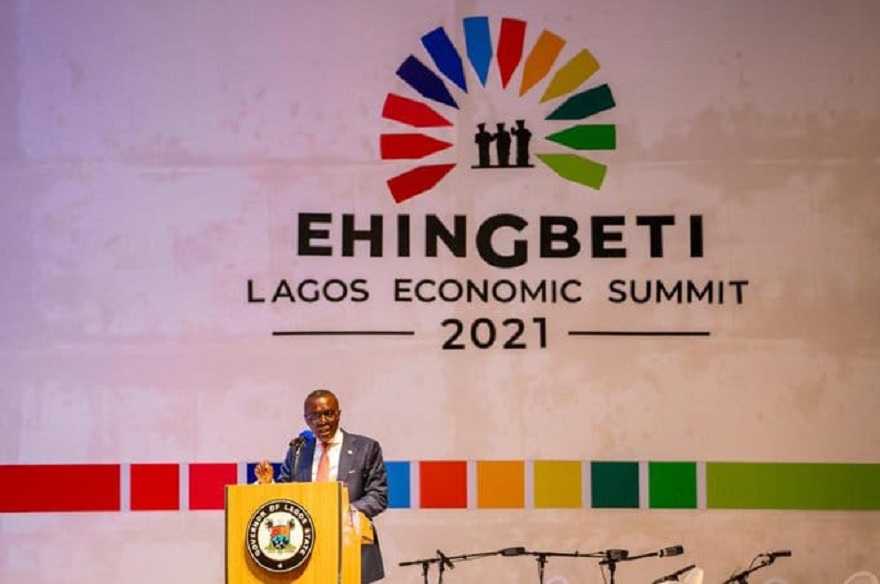
The Lagos State Governor, Mr Babajide Sanwo-Olu, on Tuesday, outlined the key infrastructural deliverables being undertaken by his administration for the achievement of the Smart City agenda.
The Governor shared his vision for the state at the 8th Lagos Economic Summit, known as Ehingbeti and themed Greater Lagos: Setting the Tone for the Next Decade. The event was facilitated by the organised private sector in support of the state government.
In his address, Mr Sanwo-Olu disclosed that the race to digitise every community in Lagos has begun with the ongoing laying of 6,000-kilometre fibre optic infrastructure across the city, stressing that the Smart City plan would fully materialise by 2030 when the entire landscape of Lagos would have been covered by a network of several thousands of kilometres of fibre optic carrying broadband internet into all homes, offices and schools.
According to him, the move is to leverage technology to revolutionise business culture in Lagos by energising Micro, Small and Medium Enterprises (MSMEs) that form the backbone of the State economy.
He said, “I invite every well-meaning Nigerian to join me to look ahead at the next decade, and the possibilities that lie ahead for Lagos.
“What will Lagos State look like by 2030? There will be a city-wide network of colour-coded Metro Lines, the first two of which – Red and Blue lines – will move over 34.5 million people monthly, cutting travel time by over 250 per cent.
“In 2030, Lagos will proudly stand beside every other megacity in the world, in terms of its capacity to transport its people efficiently and responsively.”
Speaking further, he noted that “Water transportation infrastructure being put in place will make waterway transport systems a central element of life in the metropolis.
“The Fourth Mainland Bridge will come to define the cityscape of the 2020s in the same way the Lekki-Ikoyi Link Bridge defined it a decade earlier.
“By 2030, Lagos will be a Smart City, fully covered by a network of several thousands of kilometres of fibre optic infrastructure that will carry broadband internet into homes, offices and schools.”
Additionally, Mr Sanwo-Olu said, “The Smart City that is unfolding will also be home to a network of intelligent cameras that will support not only security and policing across the State, but also traffic management and data collection for urban planning.
“By 2030, Lagos will be home to one of the largest Rice Mills in the world, after we deliver our 32 metric tons per hour rice factory in Imota, which will produce 2.8 million bags of 50kg bags of rice per annum.”
The Governor said the implementation of the plan would not only create millions of direct jobs for skilled youths, but it would also empower women, who own substantial MSMEs in Lagos, adding that plans were underway in the state to reverse the tide of billions lost nationally to medical tourism.
He disclosed that Lagos was pushing ahead with a move to develop a Medical Park in Ikoyi in partnership with the private sector, which is expected to offer world-class medical and diagnostic services stating that his administration’s development blueprint, known as Project THEMES, was designed to build on the achievements of previous administrations and lay foundations for future growth.
Mr Sanwo-Olu, having reviewed the progress recorded within the past decade, said there was so much to be celebrated in the State, but added that so much was needed to be done in expanding the frontiers of growth in Lagos.
The Ehingbeti summit, which is largely virtual, has some sessions to be held physically at the Eko Hotels and Suites, Victoria Island. It is co-chaired by the chairman of Citi Bank, Mr Yemi Cardoso.
It is an initiative introduced in 2000 as a biennial event aimed at creating a credible forum to discuss and formulate policies for accelerating infrastructural development and stimulating economic growth for Lagos.
The event was virtually attended by President Muhammadu Buhari; the newly appointed Director-General of World Trade Organisation (WTO), Dr Ngozi Okonjo-Iweala; President of Africa Development Bank, Dr Akinwunmi Adesina; and founder of Mo Ibrahim Foundation, Mr Mohammed Ibrahim, among others.
The WTO Director-General made a case for the creation of massive industrial hubs to harness the potential of the youth and women in artificial intelligence and the digital economy.
She commended the Lagos Government’s action to build digital infrastructure around the city, noting that the fibre optic programme makes the state a new manufacturing hub of digital products that will shape the global economy in the next decade.
General
NNPC, Afreximbank Partner on African Energy Development
By Adedapo Adesanya
The Nigerian National Petroleum Company (NNPC) Limited on Monday said it is partnering with the African Export-Import Bank (Afreximbank) to chart a path for African energy development.
A statement by the company noted that the partnership was discussed last week, when the Group Chief Executive Officer of NNPC Ltd., Mr Bashir Ojulari, received in audience the President and Chairman of the Board of Directors of the Afreximbank, Mr George Elombi, at the NNPC Towers, Abuja.
NNPC said it set out its direction under the Enterprise First framework, positioning the company as a high-performance Partner of Choice built on execution and profitable growth.
Afterwards, both leaders agreed on a shared agenda for continental energy development and industrialisation, and to hold regular strategic sessions, the first session scheduled later in the year.
On financing, the state oil company said it led the discussion on the planned African Energy Bank (AEB), to be headquartered in Abuja, and confirmed its readiness to deepen its investment.
The Cairo-based lender was instrumental in the founding and funding of the energy bank that is soon to be operational.
Afreximbank affirmed its commitment to the company’s growth through risk-sharing, structured financing, and further refinancing to develop Nigeria’s oil and gas resources, the statement added.
General
Funding Gap: MTN, SMEDAN Eye 5 million MSMEs Via mySMEville Academy
By Modupe Gbadeyanka
To close Nigeria’s $158 billion funding gap for 40 million small businesses, the Small and Medium Enterprises Development Agency of Nigeria (SMEDAN) has joined forces with MTN Nigeria to operate a platform known as mySMEville Academy.
The aim is to reach a target of 5 million MSMEs through the mySMEville Academy, e-commerce integrations, and national policy advocacy.
The platform was created as a one-stop shop for resources, with four core areas: information, funding, infrastructure, and markets, to support a sector that contributes 48 per cent of Nigeria’s gross domestic product (GDP) but remains largely underserved.
On Tuesday, May 12, 2026, SMEDAN visited MTN’s head office alongside Angola’s INAPEM, the National Institute of Support for Micro, Small and Medium Enterprises.
Angola’s agency is studying the collaboration between MTN and SMEDAN, which led to the launch of the mySMEville partnership in November 2025.
After a pilot in Lagos onboarded 200 businesses in December, the platform rapidly grew to include over 2,600 businesses nationwide by May 2026. This rapid expansion is essential given that 80 per cent of Nigerian SMEs are currently informal and only 3.9 per cent access formal credit, leaving a staggering $158 billion annual financing gap.
Emphasising the strategic necessity of this collaboration, the Chief Enterprise Business Officer at MTN Nigeria, Ms Lynda Saint-Nwafor, said, “Our goal is simple, we want to be the best technology partner out there, helping African businesses grow fast, compete globally, and make a real, lasting impact.”
Supporting this view, the Director-General of SMEDAN, Mr Charles Odii, said the initiative represents the future of business on the continent, asserting that
“What we are witnessing here is a formidable force for economic progress. Through this deliberate Public-Private Partnership, Nigeria is aligning its public and private sectors to lead the way for Africa,” he stated.
On his part, the Senior Specialist for ICT Segment Management at MTN Business, Mr Olatunbosun Agosu, demonstrated with a live demo how the mySMEville platform, a joint effort by MTN and SMEDAN, is the “one-stop orchestrator” for Nigeria’s 40 million small businesses.
INAPEM’s Chairman, Mr Bráulio Augusto, confirmed that Angola intends to adapt the framework to its own economic reality, noting, “The key thing I learned here is the strength of the public and private sector partnership. mySMEville clearly shows what’s possible, and we will absolutely use these insights as we adapt this model back home in Angola.”
General
Marketers Raise Alarm Over Cooking Gas Scarcity
By Adedapo Adesanya
Gas marketers have expressed worries about the scarcity of Liquefied Petroleum Gas (LPG), otherwise known as cooking gas, and rising prices, with consumers paying as high as N2,000 per kg in some areas.
A press statement by the Nigerian Association of Liquefied Petroleum Gas Marketers (NALPGAM) raised concern about the erratic supply and the hike in the price of cooking gas across the country.
According to them, while prices have gone as high, they are forced to pay as much as N26 million for 20MT of cooking gas, depending on location.
“It is sad and rather very pathetic to inform the general public that the citizens of Nigeria have woken up to buy cooking gas, which should be a social item at a prohibitive cost of over N1,500per kg, while the Marketers are made to pay as much as N25,200,000, or, depending on location, N26,200,000 for 20MT of cooking gas.
“We feel that if the situation is not immediately checked, the citizens may rise against the owners of gas filling stations.
“This sad situation has brought untold hardship to millions of Nigerian households, small businesses, food vendors, and low-income families who rely on LPG for daily cooking and livelihood.
“It is rather worrisome to state that this situation is seriously eroding the substantial progress made by the Government on the usage of Clean Energy in the country,” a part of the statement said.
NALPGAM noted that its members face challenges in sourcing LPG due to persistent supply shortages, high depot prices, logistics bottlenecks, and uncontrollable rising operational costs.
“While millions of Nigerians have embraced cooking gas as a result of the national clean energy transition agenda, it is sad to state that those gains are at risk as households are struggling to refill cylinders, small businesses are folding under rising energy costs, while many families are reverting to firewood and charcoal despite the serious implications for public health, environmental degradation, and deforestation,” it said.
The association warned that if urgent and coordinated actions are not taken immediately, the current crisis could trigger broader consequences, including accelerated food inflation, the collapse of small-scale LPG retail businesses, job losses, reduced investor confidence, and a significant setback to Nigeria’s clean energy and climate commitments.
It called on the federal government, the Ministry of Petroleum Resources, the Nigerian Midstream and Downstream Petroleum Regulatory Authority (NMDPRA), the Nigerian National Petroleum Company (NNPC) Limited, domestic producers, terminal operators, international suppliers, and all critical stakeholders in the LPG value chain to take urgent, coordinated steps to stabilise the market before it degenerates further.
It called for immediate measures to improve the availability and accessibility of LPG nationwide, increased domestic LPG allocation to the Nigerian market, ensuring transparent and equitable distribution of available supply across regions, reduction of bottlenecks in product importation, storage, and distribution, implementation of strategic interventions to stabilise retail prices, and protection of consumers.
The marketers also called for other measures, such as investment in critical infrastructure, including storage and distribution facilities, and adoption of policies that support affordability, sustainability, and long-term growth of the sector.
NALPGAM reaffirmed its commitment to constructive engagement and collaboration with government agencies, regulators, producers, and other stakeholders to develop sustainable solutions that will guarantee an affordable, stable supply and continued growth of the LPG sector.
“In conclusion, it is apposite to state that “We cannot stand by and watch millions of Nigerian families suffer in silence while access to clean cooking energy becomes increasingly difficult and unaffordable. For years, Government and industry operators have worked to move Nigerians away from unsafe fuels. Those gains are now under serious threat”, the statement added.
-
Feature/OPED6 years agoDavos was Different this year
-
Travel/Tourism10 years ago
Lagos Seals Western Lodge Hotel In Ikorodu
-
Showbiz3 years agoEstranged Lover Releases Videos of Empress Njamah Bathing
-
Banking8 years agoSort Codes of GTBank Branches in Nigeria
-
Economy3 years agoSubsidy Removal: CNG at N130 Per Litre Cheaper Than Petrol—IPMAN
-
Banking3 years agoSort Codes of UBA Branches in Nigeria
-
Banking3 years agoFirst Bank Announces Planned Downtime
-
Sports3 years agoHighest Paid Nigerian Footballer – How Much Do Nigerian Footballers Earn