

General
Money A Product Of Man, Not God—Fashola

By Dipo Olowookere
Minister of Works, Power and Housing, Mr Babatunde Fashola, has disclosed that there is nothing spiritual about getting money.
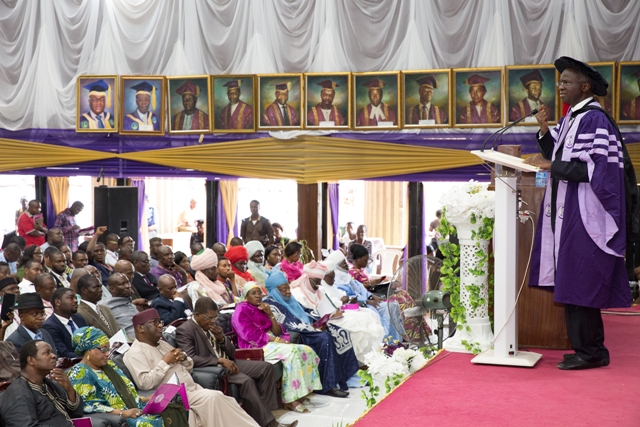
The Minister, who was addressing some students of the University of Benin (UNIBEN), Edo State recently, charged them to take away the notion that being rich is purely divine.
Mr Fashola extolled UNIBEN, saying he was to choose a school to study again, it would definitely be the tertiary institution.
Below is his full speech at the event titled ‘Freedom From Fear, Choices Before The New Generation’:
FREEDOM FROM FEAR, CHOICES BEFORE THE NEW GENERATION – BEING THE CONVOCATION SPEEECH DELIVERED BY BABATUNDE RAJI FASHOLA, SAN AT THE UNIVERSITY OF BENIN ON THE 25TH DAY OF NOVEMBER 2016
Great UNIBEN.
This is the greeting amongst students on the campus of the University, and it has endured after graduation and stayed with the alumni; decades after graduation.
May this greeting endure also for all of you who graduate today, and may you fulfil your destiny of greatness as products of a great institution and citadel of learning.
That this university is great is beyond argument now.
The evidence of this abounds in the human capital supply she has produced for Nigeria in fulfilment of the objectives of founding fathers.
It is a rich store of personnel, not only in quantity, but defining in quality.
In all spheres of Nigeria’s developmental endeavour, there is a representative of great UNIBEN, not only in a participatory role, but also in a leadership role that is setting worthy and commendable examples.
The boys and girls of yesterday have become the men and women who define the developmental character of our nation and they are waiting for you all to join them to play your role.
Therefore, I intend to start my interaction with you today by telling a story.
Many years ago, sometime in 1983, in a Philosophy classroom, a lecturer was telling his students about the theory of evolution, based on the Big Bang and atomic perspective of our evolution.
He charged them not to believe things that were not demonstrable by evidence.
He taught them about cause and effect relationships of man’s existence and that everything was ultimately traceable to Matter – something that can be seen.
The students it appeared seemed to enjoy this explanation of life and their own existence; the problem was that it debunked their understanding of faith, religion and God.
They had grown up believing, as Christians and Muslims, that there is God. But they could not see him. How were they going to resolve this matter of ‘Matter’ and science on one hand, God on the other hand.
This lecturer professed no faith, and did not believe in God, or so the students thought, until one fateful morning when one of the students sighted the lecturer walking out of church after a Sunday morning service.
Bewildered, confused feeling misled or deceived by a teacher who told him not to believe where they did not see or could not prove, (and this in the student’s mind extended to God) and to see the purveyor of that view walking out of church, with Bible in hand, was the biggest betrayal that was not going to pass unchallenged.
The student walked up to his teacher, quickly conveyed his courtesies of “Good morning sir” and the following conversation ensued:
“What are you doing there sir? You came to church?”
“Yes,” answered the teacher. “I worship here every Sunday.”
“You believe in God?”
“Yes I do.”
“Why have you been deceiving us?”
“How have I been deceiving you?”
“You taught us to believe that God does not exist since we cannot prove it,” the student said.
“No. I did not. I believe in God,” the teacher replied.
“My faith is different from my job. Your school is training you to become lawyers.
“They have employed me to develop your minds to question and challenge things. To seek knowledge, never to be easily satisfied.
“To think, and to challenge the existing order, to drive change and never to settle for the path well-travelled.
“To dare and to dream, to seek new ways of doing the same thing, because as lawyers, people’s fates will be defined by choices you make.
“Their lives will sometimes depend on your abilities, as will their businesses or their marriages. That is my job.
“Whether you believe in God or not is not my business. That is your personal choice.”
Ladies and Gentlemen, that is as best as I can recall this event.
The school where this event happened is where we gather today. The great University of Benin.
The faculty that offered the course in Philosophy is the Faculty of Law.
The lecturer was either Greek or Cypriot. His name was Theodoropolous. I was the student in question.
That encounter shaped my life in many ways; and even if I say so, I am the better for it having gone through it.
If I had to choose a university again, it would be University of Benin.
It is that experience I had that I feel bound to share with you today as you leave the University.
If I successfully connect with only one of you, I believe the effort will have been worthwhile.
That is why I have titled my intervention: “FREEDOM FROM FEAR, CHOICES BEFORE THE NEW GENERATION”, in the hope that I will challenge you to take control of what happens to you and what happens around you.
I say this because there seems to be an increasing manifestation of our collective surrender of our individual choices and free will to divine intervention and the possibility of endless miracles.
We are now in the realm and reality of constant expectations of miracles and divine intervention.
Superstitions have taken over reason and logic.
When we pass examinations, win football matches, conduct successful elections, or achieve any feat, we seem all too frightened and unsure of ourselves to take credit for even the most modest of successes attributable to our efforts.
The first thing you hear is God did it.
For the avoidance of doubt, I believe in God, and only He can question my faith.
But I also believe He gave us a lot of free will.
Regrettably, we have surrendered our capacities and abilities in a frightful way to FEAR, that we have become victims of some confidence tricksters who deceive, disentitle and prey on our fears and frailties in ‘gods’ name.
Every man and woman of substance now has a Pastor, Imam, Spiritualist or even a witchdoctor or Dibia who is responsible for telling them what to do, when to do it, in a way that diminishes his abilities and surrenders his talents and free will to divine intervention or spiritual consultation.
Many people are disappearing and are being murdered in a crazed quest for human parts because some who have been entrapped in fear and superstition, believe that you can make money through ritual sacrifice.
Nothing can be further from the truth.
Human parts are tissues, bones, muscles and all that, and they have no place in the materials used to manufacture money.
There is nothing Divine in money making. It is entrepreneurship, production and hard work.
The teaching of science as espoused by Theodoropolous tells me that money is a product of man and not a product of God.
It is manufactured in a place called a Mint, by a process of printing, using special paper, ink, engravement and embossment, to make it difficult to fake or counterfeit.
When we play a football match and get to half-time, which is a few precious minutes to quickly refresh, renew and re-plan in the dressing room, we instead gather to pray, on the field, in a huddle that the whole world is still trying to fathom.
We waste the precious time that is allotted for tactical review, and return to the second half, singing and praying, “He is a miracle working God” in search of divine intervention.
The truth is that we have done well when we prepare and done badly when we do not.
Sometimes of course, working hard does not always bring the expected results but it is better than not working hard.
Yes, God is a miracle worker. I believe, but he is not an unjust God who rewards those who make no effort at the expense of those who do.
I once listened to a sermon broadcast on Television, asking people who are indebted to step forward for prayers that will make their debts disappear.
It frightens me. It does not make sense to me.
Debts are accounting, matters of credits and deficits. They do not vanish.
It is people who live in FEAR who fall prey to such teachings and become victims of misery from poor choices.
I urge you to free your minds from such fears.
There are many teachings about freedoms.
Freedom from want, Freedom of Associations, Freedom of speech, freedom of choice (including the choice of leadership by voting at elections) and many others.
But the least expressed freedom, is the freedom from FEAR, which in my view is the most important.
A mind taken over by fear cannot express free will and will therefore not fully optimize or benefit from the other freedoms.
For example, we have seen that elections are conducted in other parts on the basis of polls, campaigns, analysis of human behaviour rather than any occultic or sacrificial offering.
Candidates who wish to win elections must persuade people to agree to their messages and promises, and seek to change the minds of those who are unpersuaded, by understanding what they want and taking steps to address them.
Those who may not be initial converts can change their minds, as we have seen in our own President who finally won after 3 (THREE) unsuccessful attempts.
For those who do not know, let me share with you some of the things that President Buhari did to win the last election.
A poll was conducted across Nigeria and administered to 20,000 Nigerians as a sample, with each person answering 60 (sixty) questions administered face to face.
That meant that the poll had to analyse 1,200,000 (ONE MILLION, TWO HUNDRED THOUSAND) responses on what Nigerians wanted in the 2015 election.
The top 3 (THREE) were security, corruption and economy, which was to form the core of candidate Buhari’s campaign message that produced President Buhari. This is how to win elections.
Polls are of course not fool proof. They can be manipulated or misinterpreted by those who analyse data. They can also be misunderstood . – Hillary leading but had over 60% Trust deficit.
Let me tell you another story related to me. This is the story of the ram.
A friend related to me how his mother had a bad dream concerning his well-being.
The dream was related to the mother’s Imam.
His response was that there had to be a sacrifice.
I interrupted by asking if the sacrifice involved buying a ram and he said yes.
Seeking to know how I knew. My response was that Ileya (the Muslim festival of Eid-El-Kabir) of Ram sacrifice was 3 (THREE) weeks away and (at the time) any trickster who could not afford one would find foul or fair means to get a ram even though Islam does not make it a matter of compulsion.
Whilst I am not passing any judgement on the Imam and any other man of God, because I cannot question their faith, the coincidence was just too uncanny. Yet I agree I may be wrong.
However, I do not see how sacrifices are solutions to dreams.
Dreams are scientific events occurring as a result of the Rapid Eye Movement during sleep at a stage when our brains are most active.
Let me reiterate again that I have no quarrel with faith. What I seek to advocate is the lack of FEAR, and the resort to faith out of conviction rather than as a result of FEAR.
Fear takes choices away, and choices can and must be the product of conviction.
If we pursue our choices with as much conviction as we pursue our faith, we will certainly be a more prosperous society.
Let us remember, that at least the two dominant faiths are not original to us. They are inherited. The propagators of the faith have made them personal affairs and not public ones.
I have attended meetings in the West and in the Middle East and not on one occasion have these meetings been started or ended with prayers.
Meetings represent public undertakings and places of work and productive undertakings to deliver prosperity.
When those people have worked hard for the week, they go on Fridays and Sundays to their places of worship and their homes to offer prayers, for God to bless and prosper the work of their hands.
Sadly, back home, the head of Governments, heads of ministries, and businesses, devote early mornings at work to prayers with their staff while productive man hours tick away, they do the same at home and on weekends, we socialise.
In effect we spend a lot of time praying and socializing.
How can this lead us to prosperity? If this is not faith influenced by fear, I do not know what it is.
If you visit many construction sites where the Chinese are employed as contractors, you will find that they work on Sundays, but we who have unemployment challenges, do not often work on Sunday.
We have invested a worrisome amount of money in building places of worship compared to what we have in building factories, businesses and schools.
This is worrisome compared to the investments I see in businesses and schools that outstrip investment in places of worship in the West and Middle East.
Recently, while driving along a road of not more than 5 (FIVE) kilometres in a Nigerian city, a colleague and I took an unplanned census of building types and this is what we counted:
a) 1 laundry outfit for washing and dry cleaning clothes (Job place)
b) 3 clinics for healthcare (Job place)
c) 2 petrol filling stations (Job place)
d) 1 bank branch (Job place)
e) 4 shopping outlets (Job place)
f) 1 eatery (Job place)
g) 10 religious houses (Worship place)
As you go around your states and neighbourhoods, I urge you to do a similar count and tell your neighbour what you see.
Again I reiterate, I do not criticise worship, but I am challenging you to think through the choices you will make.
We will not pray our way out of recession, we will plan, and produce our way back to prosperity and out of recession and you are the freshest, youngest and most energetic workforce we will have to work with.
You are the new batteries to power the engine of growth of our country.
Your choices must be clear, free from fear, not reckless but driven by analytical thought, questioning and probing and ultimately determined by convictions.
In order to test the consequences of choices based on faith influenced by fear, I advise you to look at the world map and 2 (TWO) Island nations who are situated on the Northern Hemisphere.
I will not tell you their names. You find that out. But I will tell you they are close to each other. One believes in God and works hard. The other one is the home of voodoo and spends all time practising this.
If you follow their history, the first one is prosperous and the second one seems to have made a permanent contract with poverty.
This can be changed if and when they make the right choices.
While still on this matter, let me speak about traditional medicine as distinct from divination.
Traditional medicine, from herbs, roots, and other endowments
of nature have their place of pre-eminence in the assurance of our wellbeing and good health.
I cannot say the same thing about divination and sacrifices.
We must choose to work our iron ore to produce steel and build skyscrapers, machines and tools like others do instead of worshipping the god of Iron.
We must use engineering to manage and control flooding and erosion.
We must probe the treasures of our forests and depths of our oceans as bastions of possibilities that we must manage and dominate instead of worshipping the god of the sea.
If we continue to fear the sea, oceans and waters we will perpetuate the practice of sacrifice, instead of undertaking the enterprise of understanding; and dominating them for energy and transport.
We must approach our rock formations as treasure troves of building materials like marble, tiles and granite rather than treat them as totems of salvation that require animal sacrifice.
We should stop deifying the moon and stratosphere beyond the visibility of our eyes out of fear.
Instead we should develop the courage and resolve to send men and women to land a space craft there.
I fully understand that some of you who have been raised in an environment dominated by your fear, may have been adversely affected by it.
But let me assure you that freedom from fear is not the same as courage. Instead while fear is an emotion, freedom from it is the ability to overcome it by refusing to surrender to it.
It comes from developing an ability to question things, to challenge the existing order and create a new order.
It has been done before. It requires us to know our choices and beliefs and dispense with culture that is not dynamic.
That is why twins survive today. We stopped killing them and turned our backs against a Philistinic practice that was masquerading as a culture.
If you surrender to fear, people less educated, less intelligent and less qualified than you will take over your minds, your homes and your decision making powers.
Many of such people are confidence tricksters who will prosper at your expense by preying on your fear.
Therefore, let me say to you that while your education may not be perfect, while there may be challenges, there is room to improve on it, because your education does not end here.
Indeed, your education has just started.
What you have learnt in the controlled environment of university classrooms will be subject to the test of real life situations.
How you improve and educate yourself depends on how you use your minds.
For example, do you simply repeat and reaffirm what you hear people to say simply because they are highly placed and supposedly intelligent?
Do you verify it yourself before repeating it to others ?
Do you ever ask yourself if those people could be wrong? Yes, they can be. We are all flawed.
Do you ask yourself whether those you quote without question even read as much as you do?
Do you think in terms of these words:- “Impossible”, “Improbable,” “Unlikely” ?
If you do, please stop it. They are symbols and signposts of fear.
Almost everything that was once thought impossible, improbable, unlikely has happened.
Men and women now fly thousands of Kilometres in the sky. They eat, sleep, even now shower on the Airbus A380, an engineering feat delivered by engineers of Airbus and Boeing who started out life like you, as young graduates like you.
There are now driverless cars, and men have landed on the moon and have communicated back to Earth on missions driven by freedom from fear, sheer dedication, hard work and an indomitable spirit that refused to surrender to divination, but persevered against the odds of failure before success was achieved.
But these men and women who have freed their minds from fear are not done. They are pushing to send men to Mars – The Red Planet, they are looking for cures for cancer, alzheimer’s and other diseases.
This will be the work of science, research and engineering driven by freedom from fear, not by prayer, or sacrifice of fetish to some inanimate deity.
How do you free your mind from impossibility, improbability, and unlikelihoods?
The answer is simple. Remember always, that those words are negatives. Replace them with positive thoughts and actions.
This is what frees your mind from fear and helps you to choose, to see solutions and to look for opportunities, instead of dwelling on and surrendering to problems.
If you see unmanaged refuse as a problem, you may not think of recycling and re-use and the economic opportunities that have multiple benefits, including the ultimate removal of the refuse.
If you dwell on traffic gridlock as a problem, you are unlikely to focus on developing intelligent traffic management solutions like traffic lights or a radio station to manage it and create opportunities for yourself and others.
If you focus on crime and its burden, you may lose the opportunity to focus on crime management strategies like more policemen, crime detection methods, employment and training of judges.
Indeed, as they say, if you see every problem as a nail, the only solution you might evolve is a hammer.
So, please look for the positive angle of a difficult situation, because there will be one, if you look hard enough.
I urge you to free your mind from fear, reach for the skies, choose by conviction and not by fear; trust in your abilities and God given talent, take responsibility, work hard and pray if you believe.
Yes, Sango is the god of lightning and thunder, but all the sacrifices made to Sango has not generated 1 (ONE) kilowatt of electric power.
Electricity is produced by using nature’s gifts , such as gas, water, solar and wind, harnessing their capacity through turbines made from steel to serve our energy needs, not by making animal sacrifices.
I will conclude by urging you to look for the book titled “Start Up Nation” by Dan Senor and Saul Singer, it would provoke your thinking as it did mine.
I am done.
Congratulations on your graduation. May the wind be behind your sails as you set forth in the journey of life.
May you fulfil your true promise, and may you be free from fear so that you can make good choices in your contribution to our national development.
Thank you for listening.
Babatunde Raji Fashola, SAN
Honourable Minister of Power, Works and Housing
November 2016


