
World
Organizing Committee Prepares for Russia-Africa Summit

By Kester Kenn Klomegah
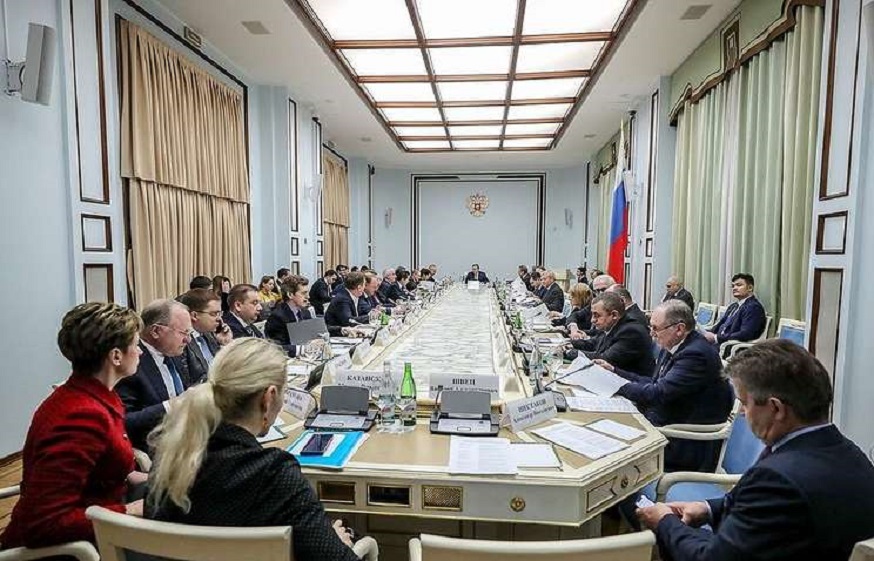
On March 19, under the Chairmanship of Yury Ushakov, an aide to the Russian President Vladimir Putin, the Organizing Committee on Russia-Africa, held its first meeting in Moscow. The Organizing Committee, established by a presidential decree, has been given the responsibility of preparing for and holding the Russia-Africa summit in October 2019 in Sochi.
The meeting was attended by representatives of the Administration of the President of the Russian Federation, the Russian Ministry of Foreign Affairs, the Russian Ministry of Finance, the Russian Ministry of Economic Development, the Russian Ministry of Industry and Trade, the Administration of Krasnodar Territory, Russian Export Center, the Roscongress Foundation and many others.
The meeting participants discussed issues related to organizational preparations for the Russia–Africa events as well as the participation of the heads of Africa states and representatives of the Russian and international business community, state institutions and governments.
The meeting participants further discussed the main preparation stages of the business program and the forthcoming meetings between the African leaders and the Russian business community, thanks to which Russia’s interaction with African countries will receive state and broad public support.
The Russia–Africa summit is expected to be attended by roughly 3,000 African businessmen, according to the official meeting report.
Anton Kobyakov, Adviser to the President of the Russian Federation, reported on the preparation progress. “It should be noted that this is an event of unprecedented scale, which has never been held before in the USSR or in Russia. The summit will be a strategically important step towards creating the most favourable conditions to develop the trade and economic relations and diversify the forms and areas of Russia–African cooperation. Economies of most African countries develop progressively, and Africa will play an increasing role in the system of Russia’s foreign economic relations in the long term, as the region becomes more and more attractive for trade and investment,” Kobyakov said.
In his contribution at the meeting, Krasnodar Governor Veniamin Kondratyev stressed that “Sochi has repeatedly proved its full commitment to hosting major international events. We will do everything in our power to ensure functioning of the entire urban infrastructure and to maintain an atmosphere of hospitality and a high level of service, which Russia has repeatedly shown when hosting guests from all over the world.”
The Roscongress Foundation together with Russian Export Center are the key institutions responsible for preparation and holding of the events for the general shareholder meeting of the African Export-Import Bank (Afreximbank) and the business conference.
“Afreximbank, being one of the continent’s largest supranational financial institutions, has held the general meeting of shareholders outside of Africa only once in its history. This undoubtedly shows the tremendous interest from the African side to develop mutually beneficial cooperation with Russia, and it will allow us to maximize the potential of these events to establish and strengthen bilateral and multilateral business relations,” according to Andrey Slepnev, Head of the Russian Export Center, who attended the meeting.
Mikhail Bogdanov, Special Representative of the Russian President to the Middle East and African countries, and Deputy Minister of Foreign Affairs, said in his speech: “Africans pin high hopes on the summit, particularly in terms of securing a course for developing constructive cooperation with Russia in solving global and regional problems, creating fair and balanced system of international relations, ensuring peace and security including joint efforts to counter terrorist threat.”
Bogdanov informed the meeting that a sizeable package of agreements in trade, economic and investment spheres and a number of other multilateral documents planned to be signed at the summit. The final document of the meeting in Sochi will be the Declaration of the first Russia–Africa summit, providing for a long-term partnership.
This first Russia-Africa summit will definitely enhance mutual multifaceted ties, reshape diplomatic relationship and significantly to roll-out ways to increase effectiveness of cooperation between Russia and Africa. Russia has traditionally prioritized developing relations with African countries. Trade and economic relations as well as investment projects with the countries of the African continent offer enormous potential. Major Russian businesses view Africa as a promising place for investment. The energy and mining sectors along with agriculture, manufacturing, transport, and infrastructure pose the greatest interest.
As a way to realize the target goals, a preliminary Russia-Africa Business Dialogue as part of the St. Petersburg International Economic Forum (SPIEF) will take place on June 6–8, and will be followed by the annual shareholders meeting of African Export-Import Bank. Russian Export Center became a shareholder in December 2017.
The African Export-Import Bank and the Russian Export Center along with SPIEF will lay the foundation for continuing the dialogue between countries at a high level as part of major subsequent business events. The Roscongress Foundation, established in 2007, is a socially oriented non-financial development institution and a major organizer of international business conventions, exhibitions and public events. The idea to hold a Russia-Africa summit was initiated by President Vladimir Putin at the BRICS (Brazil, Russia, India, China and South Africa) summit in Johannesburg in July 2018.










By Adedapo Adesanya
African Export-Import Bank (Afreximbank) has posted a robust financial performance for the 2025 financial year, with total assets and contingencies climbing to $48.5 billion.
This further shows its growing influence in financing trade and development across Africa and the Caribbean.
The Cairo-based multilateral lender, in its audited results released on April 9, reported a 21 per cent surge in total assets from $40.1 billion in 2024, underscoring sustained balance sheet expansion despite global economic headwinds and rating concerns.
Net loans and advances rose by 16 per cent to $33.5 billion, driven by strong disbursements into critical sectors including manufacturing, infrastructure, food security and climate adaptation, areas seen as pivotal to Africa’s long-term economic resilience.
Profitability remained strong, with net income climbing 19 per cent to $1.2 billion, up from $973.5 million in the previous year. Gross income also edged higher by 6.06 per cent to $3.5 billion, reflecting steady revenue growth supported by the bank’s expanding portfolio of trade finance and advisory services.
Afreximbank maintained solid asset quality, with its non-performing loan (NPL) ratio at 2.43 per cent, broadly stable compared to 2.33 per cent in 2024. This performance highlights disciplined risk management even as lending volumes increased across diverse markets.
Liquidity remained a key strength. Cash and cash equivalents rose significantly to $6.0 billion from $4.6 billion, while liquid assets accounted for 14 per cent of total assets, comfortably above the bank’s internal minimum threshold of 10 per cent.
Shareholders’ funds grew 17 per cent to $8.4 billion, supported by the strong profit outturn and fresh equity inflows of $299.4 million under its General Capital Increase II programme. The bank’s capital adequacy ratio stood at 23 per cent, well above regulatory benchmarks, providing a solid buffer for future growth.
Operating expenses increased to $459.2 million from $367.7 million, reflecting staff expansion and inflationary pressures. However, Afreximbank retained cost discipline, with a cost-to-income ratio of 21 per cent, still significantly below its 30 per cent ceiling.
The bank successfully tapped international capital markets, raising over $800 million through Samurai and Panda bond issuances in Japan and China during the year. The move helped counter concerns raised by some rating agencies and reaffirmed Afreximbank’s strong funding access and credibility.
Commenting on the results, Senior Executive Vice President, Mrs Denys Denya, said the performance reflects resilience and strategic execution amid a challenging global environment.
“Despite continuing global geopolitical challenges and disruptions caused by some rating actions, the Group delivered excellent financial performance in 2025,” he said.
He noted that the results cap a decade of transformative leadership under the erstwhile President, Mr Benedict Oramah, with the bank already ahead of most targets under its Sixth Strategic Plan, which runs through 2026.
Mr Denya added that newer subsidiaries, including the Fund for Export Development in Africa (FEDA) and AfrexInsure, are now profitable, contributing to earnings growth and strengthening the group’s diversified structure.
“The Group’s balance sheet is at its strongest level ever, with liquidity levels and capitalisation well above target and good asset quality,” he said.
Afreximbank said it is entering the 2026 financial year with strong momentum, positioning itself to scale impact, deepen trade integration and drive value addition across “Global Africa.”
Return metrics remained stable, with return on average equity at 15 per cent and return on average assets improving slightly to 3.04 per cent, signalling efficient use of capital.
With a fortified balance sheet, rising profitability and sustained investor confidence, Afreximbank said it is firmly on track to consolidate its role as a key engine of trade-led growth across the continent.

By Adedapo Adesanya
Pan-African multilateral financial institution, the African Export-Import Bank (Afreximbank), has approved a $10 billion Gulf Crisis Response Programme (GCRP) to insulate African and Caribbean economies, financial institutions and corporates from the impact of the ongoing Iran war.
The GCRP builds on a series of timely emergency interventions introduced by the lender in recent years, which have helped cushion most economies from the impact of recent shocks such as the commodity shock of 2015/16, the COVID-19 Pandemic of 2020/2021 and the Ukraine crisis of 2023/24.
The latest conflict, which escalated on February 28, 2026, has sent shockwaves through the global economy, with African and Caribbean economies bearing the largest share of the brunt. These impacts specifically affect nations that heavily rely on fuel, fertiliser, and food imports, alongside those exposed to Gulf shipping corridors, investment flows, tourism and remittance inflows.
According to Afreximbank in a statement on Tuesday, GCRP is designed to, among others, sustain essential imports – including fuel, LNG, food, fertiliser, pharmaceuticals – by providing vital short-term Foreign Exchange (FX) and liquidity to support vulnerable member states. It further aims to empower African energy and minerals exporters to capitalise on elevated prices and rerouted trade flows by scaling productive capacity in strategic commodities through pre-export finance, working capital, and inventory financing. Additionally, it provides short-term relief to African and Caribbean member states whose tourism and aviation industries have been adversely impacted by the crisis.
The programme is also designed to build the medium to long-term resilience of African and Caribbean economies against future shocks by scaling productive capacities for producers and exporters of energy, minerals while accelerating the completion of critical energy, port, and logistics infrastructure projects in African and Caribbean member states, delayed by the conflict.
Commenting on the facility, launched on March 31, 2026, Mr George Elombi, President and Chairman of the Board of Directors at Afreximbank, said: “This crisis response programme is in tune with our DNA. We understand how our economies work and the pain points associated with these transitory crises. The programme will support African countries in adjusting smoothly to the crisis while strengthening their resilience to future shocks through interventions that transform the structure of their economies.”
Through GCRP, Afreximbank has already begun taking proactive steps through partnerships with banks and corporates to secure fuel, other energy supplies, fertilisers, and essential food imports, whose supplies have been interrupted by the elongation of the crisis.
Beyond the financing, Afreximbank will spearhead a coordinated regional response in partnership with the UN Economic Commission for Africa (UNECA), the African Union Commission (AUC), the African Continental Free Trade Area (AfCFTA) Secretariat, and the Caribbean Community (CARICOM) Secretariat to strengthen regional coordination on energy security, trade resilience, and supply chain diversification.

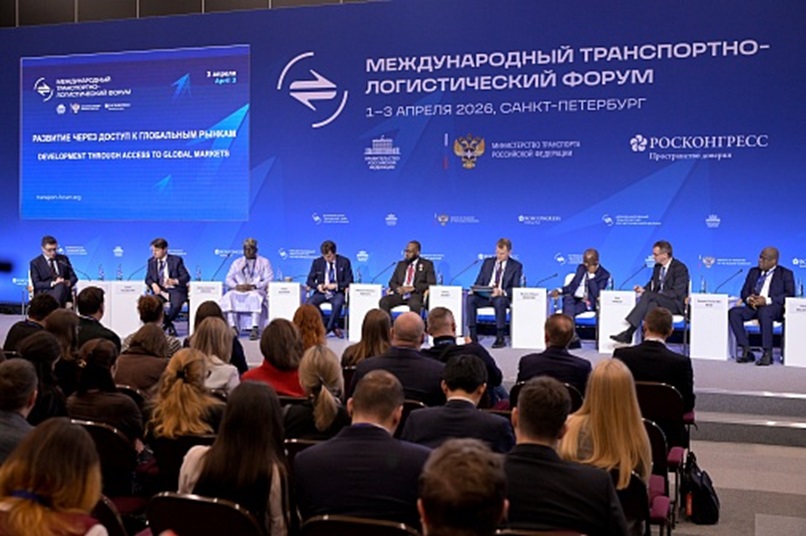
By Kestér Kenn Klomegâh
At the plenary session under the theme “Development Through Access to Global Markets” organised during the first International Transport and Logistics Forum held in St. Petersburg, both Russian and African speakers have acknowledged, in their high-quality presentations, the importance of fostering understanding of transport innovations, shifting investment and the possibility of addressing current infrastructure challenges for economic growth.
In promoting comprehensive cooperation in the transport and logistics sphere, Deputy Minister of Transport of the Russian Federation, Dmitry Zverev, stressed that the African continent is one of the fastest-growing regions of the world, demonstrating an average GDP growth rate of 4.5% per year.
According to expert projections, by 2050, Africa’s population will reach 2.5 billion people. To ensure logistical links, it is necessary to build a clear and understandable dialogue with partners, working simultaneously at two levels: at the level of governments, through intergovernmental agreements, and at the level of co-business partnerships. Russian transport corridors guarantee the stability of supplies. Today, there are issues of food security, fertiliser supply and formation of new chains, and other emerging geopolitical challenges facing Africa.
As the guest/main speaker, Zverev explained that Russian companies such as FESCO, RZD, GLONASS and Avtodor are actively involved in this process. This is a unique experience sharing technology and infrastructure solutions in significant volumes. “And frankly, that’s an important image distinction of Russia: we’re not just exporting or selling something – we’re offering technologies and cooperation. Together with technologies, we provide training and prepare national personnel who will work on their transport infrastructure in the future,” asserted Zverev.
Minister of Energy and Infrastructure of the United Arab Emirates, Suhail Mohammed Al Mazrouei, spoke of his country’s decision to invest significant money in the development of its railway infrastructure, with work already underway to connect to Oman by rail and open up new opportunities for freight transportation to Africa and Asia.
“We continue to invest in the development of our country’s logistics network and alternative routes. Russia is an important exporter of raw materials, and development in its regions will contribute to economic growth across the globe. Central Asia is also emerging as a key player, and we are investing in the region’s infrastructure and connecting China to the global economy through Russia and the Middle East,” he said.
Minister Delegate for Maritime Economy of the Ministry of Maritime Economy, Fisheries, and Coastal Protection of the Togolese Republic, Kokou Edem Tengue, spoke of the importance of understanding the African perspective on changing maritime routes as the situation around the Suez Canal and the Strait of Hormuz creates new opportunities for West Africa.
The Port of Lomé, the largest container port in Sub-Saharan Africa, handles approximately 30 million tonnes of goods annually, and its importance for the region is difficult to overstate. “We are actively working with Mali, Burkina Faso, and Niger; the Port of Lomé is a key logistics hub for the landlocked nations of the Sahel,” he said. “It should be noted that Africa relies on chemical fertilisers and grain produced in Russia. We believe that the Port of Lomé could be a part of new sea routes between Africa and Russia.”
In his speech, Minister of Transport of the United Republic of Tanzania, Makame Mnyaa Mbarawa, reported on the active modernisation of the Dar es Salaam port. Previously, the depth of the water was 9–12 meters; now it has increased to 12–15 meters. An increase in the number of operators operating in the port is planned. Thanks to these measures, cargo turnover increased significantly, and ship handling times decreased from 10 days to 2–3. This is an important achievement, after all, speed is a key factor for investors.
However, the port cannot function in isolation; it needs modern rail infrastructure. Tanzania’s government is leading the construction of a new railway to Kigoma, and then into Burundi and south, creating a reliable transportation artery. Dar es Salaam will become a gateway to Burundi, Rwanda, Malawi and Zambia, which depend on cargo flow through this port. Therefore, the development of the port and associated railway is of strategic importance in the region.
“In parallel, the modernisation of the TAZARA railway is going on – a historic artery that requires an upgrade. The private sector is actively involved in this work. After revitalisation, this line will become a key link between Dar es Salaam port and Zambia, he stated. The Government of Tanzania will make every effort to implement these projects and will work closely with the private sector. We invite Russian companies – both state and private – to participate in logistics projects and port infrastructure modernisation.”
As far as road safety in Niger is concerned, the country is facing various challenges that require finding ways to improve the situation, according to the Speaker from Niger, Abdurakhaman Amadou. Within the framework of the discussion, he also noted that an important step was to upgrade the car park and road network. As Niger has no access to the sea, the emphasis is on road traffic to ensure the country’s supply.
“We have access to the port of Lome in the Togolese Republic, which remains neutral towards us. However, the Caton port is closed for us, which created serious difficulties as 80% of our exports and imports passed through it. Recently, the situation has started to improve due to the construction of a railway by Nigeria, which will provide us with access to its ports,” Abdurakhaman informed.
In addition, diplomatic relations with Algeria have been restored after a long hiatus, which opens an exit to the Mediterranean. The conference of Islamic states confirmed the intention to build a grand railway linking Dakar and Djibouti across the entire continent from west to east. This railway will partially pass through Niger, which will be an important step in the development of the region’s transportation infrastructure.
President Vladimir Putin, in a message to participants, organisers, and attendees of the International Transport and Logistics Forum, says that Russia is ready to share its experience through joint science and technology programmes and, of course, by training specialists able to ensure the development of transport and logistics in the 21st century, using a new technological foundation. The Transport and Logistics forum was held for the first time on April 1-3 in St. Petersburg, the second-largest city in the Russian Federation.
-
 Feature/OPED6 years ago
Davos was Different this year
-
Travel/Tourism10 years ago
Lagos Seals Western Lodge Hotel In Ikorodu
-

 Showbiz3 years ago
Estranged Lover Releases Videos of Empress Njamah Bathing
-
 Banking8 years ago
Sort Codes of GTBank Branches in Nigeria
-

 Economy3 years ago
Subsidy Removal: CNG at N130 Per Litre Cheaper Than Petrol—IPMAN
-

 Banking3 years ago
Sort Codes of UBA Branches in Nigeria
-

 Banking3 years ago
First Bank Announces Planned Downtime
-

 Sports3 years ago
Highest Paid Nigerian Footballer – How Much Do Nigerian Footballers Earn