Connect with us

Brands/Products

Strong Visibility Positions Nigerian Banks, Tech for Investor Confidence

Published

on

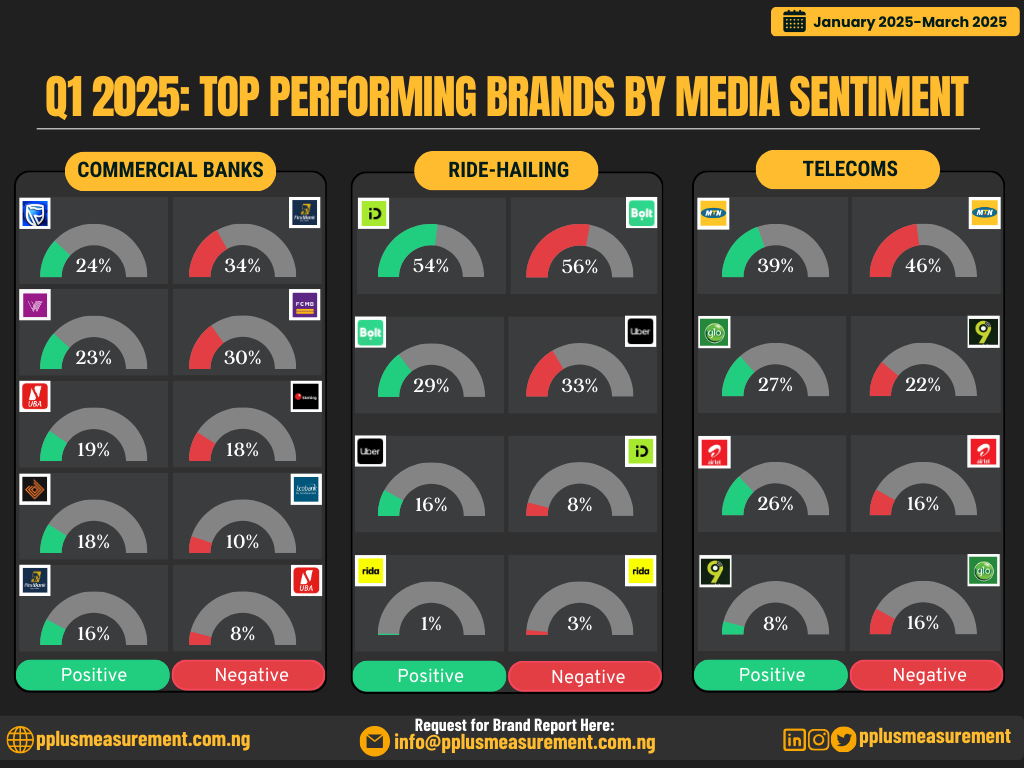
Q1 2025 Top Performing Brands by Media Sentiment

Following the Central Bank of Nigeria’s directive to harmonize exchange rates and the subsequent spike in the dollar-to-naira rate—reaching over ₦1,600/$1 in official markets— Nigeria’s commercial banking, ride-hailing, and telecommunications sectors demonstrated media resilience in Q1 2025. This is the key insight from a comprehensive sentiment audit by P+ Measurement Services, Nigeria’s foremost media intelligence consultancy, which analysed over 1.3 million online publications and 2,100 print media articles locally and globally during the period.

Leveraging advanced media intelligence frameworks, the Q1 2025 analysis encompassed data from 28 commercial banks, 4 major telecommunications providers, and 4 leading ride-hailing platforms. The study deployed rigorous monitoring, measurement, and auditing techniques, drawing from structured metadata points such as editorial tone, CEO visibility, public discourse, and brand-specific media traction. By quantifying sentiment across these variables, the analysis offers a strategic lens into how media narratives—beyond operational milestones—are actively shaping brand trust, credibility, and relevance across Nigeria’s core economic sectors.

Commercial Banks: Visibility, Trust, and Turbulence

Q1 media sentiment around Nigeria’s banks showed a polarity in perception. Stanbic IBTC Bank emerged as the frontrunner in positive coverage, responsible for 24% of favorable sentiment across the industry. Wema Bank (23%), UBA (19%), Access Bank (18%), and First Bank (16%) followed closely. Their visibility was supported by initiatives such as Wema Bank’s 80th anniversary campaign and UBA’s ₦41 million customer reward promo.

However, First Bank, while present in positive narratives, also carried the burden of 34% of all negative sentiment. FCMB (30%), Sterling Bank (18%), and Ecobank (10%) followed, driven by litigation, regulatory reprimands, and negative market performance. These data points indicate that while strategic PR efforts amplified brand equity for some, crisis events significantly dampened sentiment for others.

Ride-Hailing: Innovation Meets Scrutiny

Among ride-hailing operators, inDrive dominated favorable mentions at 54%, aided by product enhancements like the “Light Cashless” bank transfer feature. Bolt (29%) and Uber (16%) also maintained a strong share of voice. Yet, sentiment was bifurcated. Bolt attracted 56% of all negative coverage, largely due to safety concerns and regulatory backlash. Uber followed with 33%.

Media narratives were significantly influenced by driver protests, public safety incidents, and the call for federal-level e-hailing regulations. These contributed to rising brand scrutiny despite aggressive service innovation.

Telecoms: Leadership in Spotlight, Policy Driving Talkability

In telecommunications, MTN Nigeria led positive sentiment at 39%, with Airtel (27%) and Globacom (26%) closely trailing. MTN’s “Go M.A.D” youth empowerment initiative stood out, as did Globacom’s roll-out of SIM-less eSIM technology.

Yet, MTN also bore the brunt of negative sentiment 46%, fueled by union threats and consumer backlash over tariff adjustments. A turbulent leadership transition at Globacom and an ongoing ownership saga at 9mobile contributed to reputational headwinds. Notably, telecoms media narratives in Q1 were driven as much by policy shifts and service upgrades as they were by instability and consumer rights activism.

The Media Intelligence Lens: Contextualising Sentiment Drivers

From an analytical standpoint, the divergence between positive and negative sentiment reflects not just brand activity, but the underlying media mood — a composite of how editors, commentators, and the public receive and interpret brand behavior in context.

In banking, initiatives tied to financial inclusion, brand legacy, and public goodwill increased positive talkability. Conversely, regulatory breaches, fraud allegations, and legal entanglements skewed perception negatively, reinforcing the classic PR principle: “Silence in crisis equals narrative surrender.”

For ride-hailing, product enhancements were insufficient buffers against public safety crises, a trend increasingly important in a media environment where social proof, particularly from user-generated forums and review sites, plays a strong role in shaping brand trust.

Telecommunications brands faced media volatility as regulatory pricing interventions and leadership instability challenged perception management. Here, media responsiveness and spokesperson effectiveness proved critical in determining how well brands navigated the sentiment curve.

Conclusion: Media Presence ≠ Media Health

As Q2 unfolds, the Nigerian media terrain will likely remain sensitive to leadership decisions, regulatory policy, customer experience, and public safety across sectors. This Q1 analysis reinforces the idea that media presence, while important, must be accompanied by brand media health management, the strategic balancing of visibility, credibility, and sentiment.

For stakeholders, from investors and regulators to brand custodians and PR strategists, these insights form a crucial foundation for navigating reputational capital in an era where perception can often outweigh performance.


Brands/Products

Temu Partners Dellyman to Scale Logistics Capabilities Across Nigeria

Published

on

Dellyman Temu

By Modupe Gbadeyanka

As part of its strategies to aggressively scale its logistics capabilities across key African markets, especially in Nigeria, the fast-growing global e-commerce powerhouse, Temu, has entered into a delivery partnership with Lagos-based logistics startup, Dellyman.

Through this collaboration, Temu customers in Nigeria will experience faster, more predictable, and more transparent deliveries, a critical factor in sustaining the platform’s customer satisfaction as order volumes continue to rise.

Dellyman’s technology-driven approach, spanning rider management, route optimisation, and customer visibility, played a central role in Temu’s selection process.

In the pilot phase, Dellyman completed more than 1,300 deliveries with a 95 per cent success rate, demonstrating its readiness to support large-scale e-commerce operations nationwide.

Founded in 2020, the firm has grown into one of Nigeria’s most reliable same-day and last-mile delivery platforms.

The company recently achieved a 10,000-order monthly delivery milestone in November 2025, contributing to a cumulative total of more than 300,000 lifetime deliveries.

This track record made Dellyman a strong fit for Temu, which is aggressively scaling logistics capabilities across key African markets.

“Our partnership with Temu is a major endorsement of the vision we set out with, to build Nigeria’s most reliable, scalable, and transparent last-mile delivery infrastructure.

“Achieving a 95 per cent delivery success rate during the pilot underscores our readiness to support high-volume e-commerce platforms.

“This collaboration shows that local startups can meet and exceed global standards when given the opportunity,” the chief executive of Dellyman, Mr Dare Ojo-Bello, said.

He further noted that the partnership represents more than operational growth as it signals a shift in how global e-commerce brands view Nigerian logistics capabilities.

“This is not just about fulfilling orders; it is about reshaping perceptions of what Nigerian delivery companies can achieve. We are committed to building the kind of infrastructure that supports international standards, empowers local businesses, and ultimately strengthens consumer trust in the broader digital economy,” he noted.

Mr Ojo-Bello added that Dellyman will continue investing in capacity, fleet expansion, and merchant-facing tools to ensure superior delivery experiences for Temu buyers and other online shoppers nationwide.

Continue Reading

Brands/Products

Verve Issues Over 100 million Cards to Customers, Celebrates Milestone

Published

on

Verve 100 million Cards

By Aduragbemi Omiyale

Over 100 million cards have been issued to customers by Africa’s leading payments card brand, Verve, across the continent.

This milestone has been described as a powerful symbol of growth, resilience, and the evolving needs of millions of Africans who rely on Verve every day.

The accomplishment has been said to underscore the company’s deep consumer insight, continuous innovation, and unwavering dedication to customer satisfaction.

Verve’s evolution has consistently been inspired by the needs and aspirations of its users. Today, its acceptance footprint stretches across Africa and reaches global markets through strategic partnerships with leading brands, including Google, Netflix, Spotify, AliExpress, Temu, Flywire, YouTube Premium, and others, unlocking broader access to lifestyle, entertainment, commerce, and mobility solutions for millions of cardholders.

“What began as a simple idea, one card designed to empower everyday life, has grown into 100 million stories, 100 million touchpoints, and 100 million reasons to deepen our commitment to delivering secure, seamless, and meaningful payment experiences across Africa,” the Executive Vice President for Group Marketing and Corporate Communications at Interswitch Group, Ms Cherry Eromosele, said at a media briefing in Lagos, where she was represented by the Divisional Head for Growth Marketing (Paytoken and MVNO), Chidi Oluaoha.

Ms Eromosele further noted that the milestone is shared with the broader ecosystem; banks, processors, merchants, regulators, and partners, whose collaboration has fuelled Verve’s remarkable growth.

Most importantly, she celebrated the millions of individuals who carry Verve cards in their wallets and mobile devices, acknowledging that their trust and loyalty continue to inspire the brand’s progress.

With the 100-million-card mark now crossed, Verve is poised to accelerate its expansion efforts, elevate customer experiences, and strengthen its global acceptance network.

Continue Reading

Brands/Products

CREDICORP Launches Credit Programme for Easier Acquisition of Phones, Others

Published

on

CREDICORP Launches Credit Programme

By Adedapo Adesanya

The Nigerian Consumer Credit Corporation (CREDICORP)  has launched a national digital device credit programme that will make the acquisition of smartphones, laptops, and other essential digital tools easier for working Nigerians.

According to the scheme, which was introduced by the Nigerian government to democratise consumer credit access to Nigeria’s working population, the country’s progress is increasingly driven by access to the tools that help people learn, earn, and participate fully in a modern economy.

Over the past year, CREDICORP has supported thousands of Nigerians to acquire the assets that make daily life easier, from mobility solutions that shorten commutes and increase productivity to renewable energy systems that keep homes and small businesses powered and productive. Each intervention has shown the same outcome: when Nigerians are allowed to access essential tools through fair and responsible credit, their lives improve rapidly.

The new rollout builds on the success of the pilot phase already completed under the partnership. In the first phase, CREDICORP, working through E-Finance Company with technology support from Credlock, enabled over 1,000 Nigerians to access smartphones through affordable credit, many for the first time. The strong repayment performance and the speed of adoption demonstrated both the appetite and the national need for this kind of support.

Via this new phase, CREDICORP is poised to scale the program significantly, targeting over 15,000 Nigerians who will be able to access smartphones or laptops that directly enhance their productivity, income potential, and digital participation.

To deliver this initiative at scale, the organisation is once again working through one of its Participating Financial Institutions, E-Finance Company, with technology support from Credlock, whose intelligent device-collateral system allows for secure, responsible, and efficient access to credit. Together, E-Finance and Credlock will ensure that Nigerians can seamlessly apply for, finance, and collect the digital devices they need, without the heavy burden of upfront payments.

Speaking on the new phase, CREDICORP’s Managing Director, Mr Uzoma Nwagba, noted that this is a natural progression of the institution’s work.

“From mobility to renewable energy, we have witnessed the profound impact that access to credit can have on people’s daily lives. Nigerians are ambitious and hardworking; they simply need fair pathways to acquire the tools that move them forward. Digital devices now sit at the center of learning, earning, and productivity, and expanding access to them is a critical step in building a more digitally ready nation.”

On his part, Credlock’s CEO, Mr Dayo Fabayo, emphasized the power of turning everyday devices into pathways for progress. “Every smartphone represents potential to learn, to work, to access opportunity, and to live with dignity. At Credlock, we believe the device in someone’s hand can be the bridge to their financial future. Working with CREDICORP and E-Finance allows us to scale that vision to millions of Nigerians.”

This initiative is part of CREDICORP’s broader mission to expand consumer credit and improve the quality of life across the country. By widening access to digital tools, CREDICORP is supporting a more connected, productive, and future-ready Nigeria, one where every citizen can thrive.

Continue Reading

Trending