Economy
United Capital Sustains Growth in H1 2018, Records N2b Profit
By Modupe Gbadeyanka
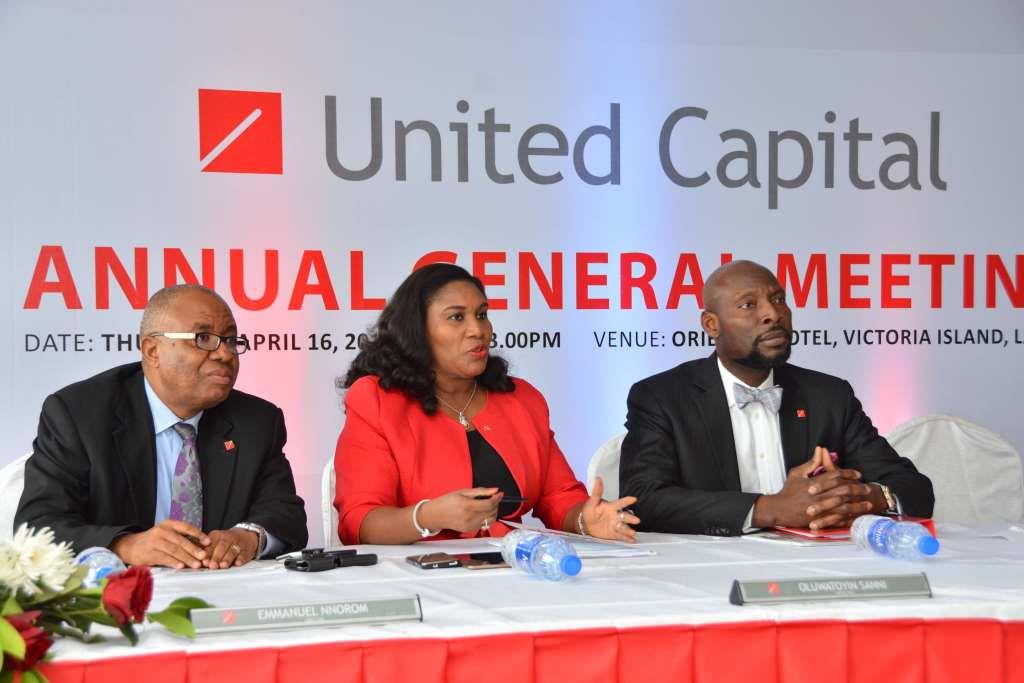
Leading Pan-African Investment Banking Group, United Capital Plc, on Thursday announced its unaudited 2018 half year financial results, showing gross earnings of N3.9 billion and Profit Before Tax of N2.4 billion, a slight increase from half year 2017.
United Capital sustained growth in earnings and profitability despite a challenging macroeconomic environment.
In spite of higher oil prices, CDP growth came in slower than expected in Q1 2018 as activities in the services sector of the Nigerian economy continue to constrain overall growth.
Also, events in the global space reversed the pace of foreign portfolio inflow into the local market amid rising interest rates in the United States and increased trade tension.
Average yield in the fixed income market moderated to 13.4 percent in June 2018, down by 0.69 percent compared with December 2017, lowering earnings yields for most financial services outfits.
Additionally, the equities market closed the period flattish as the euphoria which greeted the beginning of the year fizzled out in the later part as investors took a flight to safety.
Nevertheless, the group sustained growth in revenue and profitability, buttressing the firm’s commitment to delivering superior value to shareholders always.
Major highlights of the financial statements showed that gross earnings increased to N3.88 billion in contrast to N3.87 billion in H1 2017, while operating expenses closed at N1.49 billion against N1.5 billion in H1 2017.
Furthermore, the profit before tax was N2.39 billion compared with N2.38 billion in H1 2017, while the profit after tax stood at N2.01 billion in contrast to N1.99 billion in H1 2017.
A look at the balance sheet indicated that the total assets of the company stood at N135.3 billion against N136.6 billion as at FY 2017.
Also, the Funds under Management closed at N68.8 billion as at June 30, 2018 against N70.5 billion as at December 31, 2017, while the Shareholders’ Funds stood at N18.3 billion in the period under review in contrast to N16.8 billion as at FY 2017.
Commenting on the results, the Group CEO of United Capital, Mr Peter Ashade, stated that, “United Capital continues to pursue a clear and consistent strategy, which will always deliver a strong performance for shareholders, and we remain positive about our future opportunities within the Nigerian and African market, notwithstanding the challenging macro-economic environment.”
Economy
NGX RegCo Cautions Investors on Recent Price Movements
By Aduragbemi Omiyale
The investing public has been advised to exercise due diligence before trading stocks on the Nigerian Exchange (NGX) Limited.
This caution was given by the NGX Regulation Limited (NGX RegCo), the independent regulatory arm of the NGX Group Plc.
The advisory became necessary in response to notable price movements observed in the shares of certain listed companies over recent trading sessions.
On Monday, the bourse suspended trading in the shares of newly-listed Zichis Agro-allied Industries Plc. The company’s stocks gained almost 900 per cent within a month of its listing on Customs Street.
In a statement today, NGX RegCo urged investors to avoid speculative trading based on unverified information and to consult licensed intermediaries such as stockbrokers or investment advisers when needed.
It explained that its advisory is part of its standard market surveillance functions, as it serves as a measured reminder for investors to prioritise informed and disciplined decision-making.
The notice emphasised that the Exchange will continue to monitor market activities closely in line with its mandate to ensure a fair, orderly, and transparent market.
“NGX RegCo encourages all investors to base their decisions on publicly available information, including a thorough assessment of company fundamentals, financial performance, and risk profile,” a part of the disclosure said.
It reassured all stakeholders that the NGX remains stable, well-regulated, and resilient, saying the platform continues to foster an environment where investors can participate with confidence, supported by robust oversight and transparent market operations.
“Our primary responsibility is to maintain a level playing field where market participants can trade with confidence, backed by timely and accurate information.
“This advisory is a routine communication, reinforcing that sound fundamentals, not speculation, remain the foundation for sustainable investment outcomes. We are fully committed to preserving the integrity and stability of our market,” the chief executive of NGX RegCo, Mr Olufemi Shobanjo, stated.
Economy
Stronger Taxpayer Confidence, Others Should Determine Tax Reform Success—Tegbe
By Modupe Gbadeyanka
The chairman of the National Tax Policy Implementation Committee (NTPIC), Mr Joseph Tegbe, has tasked the Nigeria Revenue Service (NRS) to measure the success of the new tax laws by higher voluntary compliance rates, lower administrative costs, fewer disputes, faster resolution cycles, and stronger taxpayer confidence.
Speaking at the 2026 Leadership Retreat of the agency, Mr Tegbe said, “Sustainable revenue performance is built on trust and efficiency, not enforcement intensity,” emphasising that the legitimacy and predictability of the system are more critical than punitive measures.
He underscored that the country’s tax reform journey is at a critical juncture where effective implementation will determine long-term fiscal outcomes.
The NTPIC chief stressed that tax policy must serve as an enabler of governance, and should embody simplicity, equity, predictability, and administrability at scale.
These principles, he explained, foster voluntary compliance, reduce operational friction, and strengthen investor confidence. He warned that ad-hoc adjustments or policy drift could undermine reform momentum, unsettle businesses, and deter investment, which thrives on predictable rules rather than shifting announcements. Structured sequencing, clear transition mechanisms, and continuous feedback between policymakers and administrators are therefore critical to sustaining reform credibility.
Mr Tegbe further argued that revenue reform cannot succeed in isolation. Achieving sustainable gains requires a whole-of-government approach, leveraging robust taxpayer identification systems, integrated financial data, efficient dispute resolution, and harmonised coordination across federal and sub-national levels. This approach, he said, reduces leakages, eliminates multiple taxation, and reinforces confidence in the system.
He noted that the passage of four new tax laws marks only the beginning of a broader reform agenda, describing the initiative as a systemic recalibration of Nigeria’s fiscal architecture, rather than a routine policy update.
He further asserted that the true measure of success will be the credibility of implementation, not the design of the laws themselves.
The NRS, he noted, functions as the nation’s “Revenue System Integrator,” with outcomes reflecting the strength of an interconnected ecosystem that encompasses policy clarity, enforcement consistency, digital infrastructure, dispute resolution efficiency, and intergovernmental coordination.
Economy
NUPENG Seeks Clarity on New Oil, Gas Executive Order
By Adedapo Adesanya
The National Union of Natural and Gas Workers (NUPENG) has expressed deep concern over the Executive Order by President Bola Tinubu mandating the Nigerian National Petroleum Company (NNPC) Limited to remit directly to the federation account.
In a statement signed by its president, Mr William Akporeha, over the weekend in Lagos, the union noted that the absence of detailed public engagement had naturally generated tension within the sector and heightened restiveness among workers, who are anxious to know how the new directive may affect their employment, welfare and job security, especially as it affects NNPC and other major operations in the oil and gas sector.
It pointed out that the industry remained the backbone of Nigeria’s economy, contributing significantly to national revenue, foreign exchange earnings, and employment.
The NUPENG president affirmed that any policy shift, particularly one introduced through an Executive Order, has far-reaching consequences for regulatory frameworks, Investment decisions, operational standards, and labour relations within the sector.
According to him, “there is an urgent need for clarity on the scope and objectives of the Executive Order -What precise reforms or adjustments does it introduce? “Its implications for the Petroleum Industry Act -Does the Order amend, interpret, or expand existing provisions under PIA?
“Impact on workers and existing labour agreements-Will it affect job security, conditions of service, Collective Bargaining agreements or ongoing restructuring processes within the industry? “Effects on indigenous participation and local content development -How will it affect Nigerian companies and employment opportunities for citizens?”
He warned that without proper consultation and explanation, misinterpretations of the Executive Order may spread across the industry, potentially destabilising operations and undermining industrial harmony that stakeholders have worked hard to sustain.
“Though our union remains committed to constructive engagement, national development and stability of the oil and gas sector, however, we are duty-bound and constitutionally bound to protect the rights and welfare and job security of our members whose livelihoods depend on a clear, fair and predictable policy framework,” Mr Akporeha further stated.
-
Feature/OPED6 years agoDavos was Different this year
-
Travel/Tourism10 years ago
Lagos Seals Western Lodge Hotel In Ikorodu
-
Showbiz3 years agoEstranged Lover Releases Videos of Empress Njamah Bathing
-
Banking8 years agoSort Codes of GTBank Branches in Nigeria
-
Economy3 years agoSubsidy Removal: CNG at N130 Per Litre Cheaper Than Petrol—IPMAN
-
Banking3 years agoSort Codes of UBA Branches in Nigeria
-
Banking3 years agoFirst Bank Announces Planned Downtime
-
Sports3 years agoHighest Paid Nigerian Footballer – How Much Do Nigerian Footballers Earn