Connect with us

Health

China Strengthening its Diplomacy in Africa’s Health Sector

Published

on

CDC Africa Headquarters Africa's Health Sector

By Kester Kenn Klomegah

China and Africa will always be a community of a shared future. At least, its policy is strategically focused on addressing sustainable development, and China has indeed proved, over the years, in many aspects of dealing with Africa.

Results are seen especially with all kinds of infrastructure that have been built these years. And, of course, the appreciable results reflect the level of commitment to the action plans arrived at triannual summits.

In its white paper says that China’s approach involves basic principles including upholding a people-oriented approach in pursuing practical cooperation with efficiency. In its cooperation with Africa, it gives priority to the interests and wellbeing of the peoples of Africa and works to their benefit.

 China is committed to fully honouring the promises it has made to its African friends. Developing solidarity and cooperation with African countries has been the cornerstone of China’s foreign policy. In the fight for coronavirus, China will deliver one billion vaccines to Africa – with a population of 1.3 billion. This indicates further its efforts at promoting cooperation in basic healthcare delivery.

With the outbreak of coronavirus in December 2019, China was the first country in the world to convene an anti-pandemic summit with Africa. It has further called on international partners to increase support to Africa, while itself providing at various times medicament including vaccines to many African countries.

Quite recently during the last summit held in November, China’s President Xi Jinping elaborated on important policies on advancing China-Africa cooperation and strengthening cooperation amid the pandemic. In order to support, he promised one billion doses. It has made deliveries in many African countries.

China actively honours its commitment to make vaccines a global public good. At the time when Chinese vaccines had just reached the market and domestic supply was tight, China began to supply vaccines to Africa in support of its battle against the pandemic.

By November 2021, China had provided over 1.7 billion doses of the Covid-19 vaccine to more than 110 countries and organizations, including 50 African countries and the AU Commission, and is striving to provide an aggregate total of – two billion doses by the end of 2021. In addition, it donated US$100 million to COVAX, which aims at ensuring all countries have access to a safe, effective vaccine.

COVAX is a global programme coordinated by the World Health Organization in partnership with GAVI – the Vaccine Alliance, the Center for Epidemics Preparedness Innovations and many others. Producing countries are free to donate vaccines through COVAX.

Chinese firms are actively engaging in joint vaccine production in Africa with local firms, helping countries, in accordance with their wishes, to realize localized vaccine production. According to reports, Chinese firms have started localized production in Egypt and signed cooperative agreements with Morocco and Algeria.

After the Covid-19 struck, in coordination with local governments, enterprises and social organizations, China has provided emergency anti-pandemic supplies – including 120 batches of nucleic test reagents, protective gears, masks, eye protectors and ventilators – to 53 African countries and the AU based on their respective needs, with these emergency supplies reaching almost all areas across the continent. It has, in addition, sent medical teams to a number of countries on the continent.

China has also actively shared its anti-epidemic experience with African countries and dispatched anti-epidemic medical expert groups or short-term anti-epidemic medical teams to 17 African countries to fight the epidemic alongside local people.

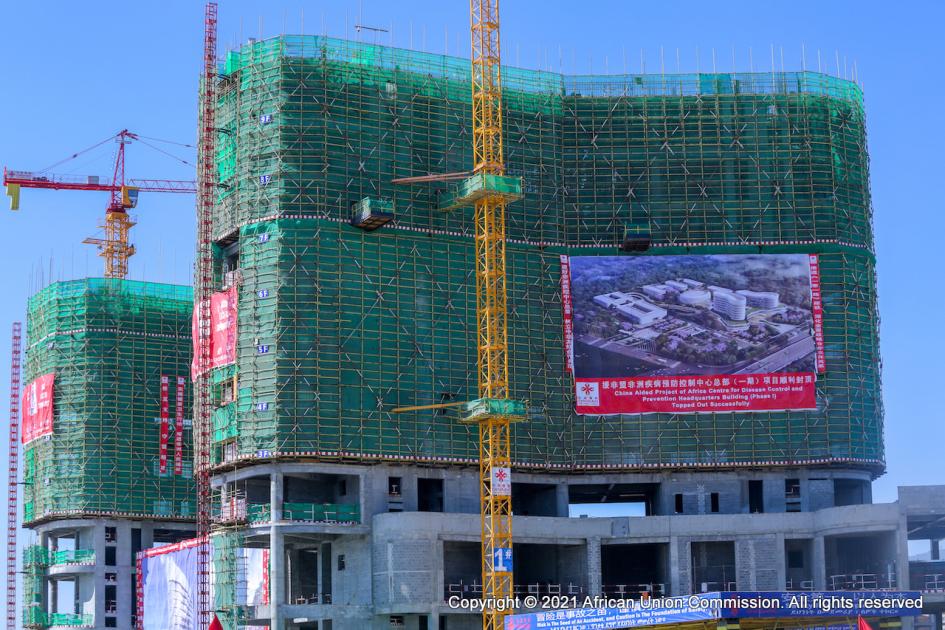
It has pushed for the earlier start of the construction of the headquarters of the Africa Center for Disease Control and Prevention (Africa CDC), a project assisted by China. This shows another huge step in undertaking the building of the headquarters of the Africa CDC located in Addis Ababa, Ethiopia.

At the 2018 Beijing Summit and the 7th Ministerial Conference of the Forum on China – Africa Cooperation (FOCAC) held in Beijing, the Government of China expressed its commitment to support the building of the Africa CDC HQ. African leaders welcomed this with appreciation and committed to supporting the realization of the project.

Located in the African Village, south of Addis Ababa, the new site covers an area of 90,000m2 with a total construction area of nearly 40,000m2. When completed the building will include an emergency operation centre, a data centre, a laboratory, a resource centre, briefing rooms, a training centre, a conference centre, offices, and expatriate apartments, all to be constructed, furnished and equipped by the Government of China.

In accordance with a number of agreements concluded between the AU and the Government of China, the AU Commission and the Ministry of Commerce of the People’s Republic of China signed the Implementation Agreement on the Africa CDC HQ’s building project in July 2020.

The headquarters building is expected to become one of the best-equipped centres for disease control in Africa, allowing the Africa CDC to play its role as the technical institution coordinating disease prevention, surveillance and control in the continent, in partnership with the national public health institutes and ministries of health of Member States.

H.E. Amira Elfadil Mohamed, Commissioner for Humanitarian Affairs and Social Development and H.E. Ambassador Liu Yuxi, Head of the Mission of the People’s Republic of China to Ethiopia attended the ceremony on behalf of the African Union Commission and the Government of the People’s Republic of China respectively.

Speaking at the ceremony, Commissioner Elfadil said the completion of the first phase marks 45 per cent of the total construction. “While celebrating our success in reaching 45% of total project completion within an impressive record of 348 days. The African Union would like to express its sincere appreciation to the Government of the People Republic of China for funding the whole project, and to all the stakeholders who have played their respective roles and tirelessly assisted the team in achieving its target,” she said.

In his remarks, H.E. Ambassador Liu Yuxi underlined the close China-Africa partnership. “As we speak, the Covid-19 pandemic is still wreaking havoc across the globe. However, it cannot prevent China-Africa cooperation from growing in depth and substance. China and Africa stand together with mutual assistance, team up amid difficulties and treat each other wholeheartedly.”

He added that the Africa CDC building itself is a manifestation of beneficial and practical work for the African people. China will proceed to try its utmost to assist African countries in responding to the pandemic and restoring economic and social development. By combating Covid-19, China and Africa have withstood severe challenges, helping each other and fighting side by side to defeat the pandemic through solidarity and cooperation.

China is participating in the African Vaccine Manufacturing Partnership (AVMP) launched by the African Union in April 2021. This Continental Vaccine Manufacturing Vision is “to ensure that Africa has timely access to vaccines to protect public health security, by establishing a sustainable vaccine development and manufacturing ecosystem in Africa.”

It is also a splendid testimony of China unflinching support for Africa. “Together, we have written a splendid chapter of mutual assistance amidst complex changes, and set a shining example for building a new type of international relations,” Xi said later in one of his speeches, and emphasizing the principles of China’s Africa policy as pursuing the greater good and shared interests.

China and Africa jointly launched an Initiative on Partnership for Africa’s Development this year. It emphasizes that all countries should carry out cooperation with Africa on the premise of respecting Africa’s sovereignty and listening to Africa’s voice, give full play to their respective advantages and pool efforts in an effective way, and do more beneficial and practical work for the well-being of the African people.

China and Africa are working closely. At the initiative of both China and African countries, FOCAC was inaugurated at its first Ministerial Conference in Beijing in October 2000, with the goals of responding to the challenges emerging from economic globalization and seeking common development. FOCAC now has 55 members, comprising China, the 53 African countries that have diplomatic relations with China, and the AU Commission.

Beyond the borders of Africa, China expresses and appeals for upscaling the development and improving the basic needs of the underprivileged peoples in Africa. While attending the General Debate of the 76th Session of The United Nations General Assembly, Chinese President Xi Jinping proposed the Global Development Initiative, calling on the international community to accelerate the implementation of the UN 2030 Agenda for Sustainable Development.


Health

Nigeria Launches First National Antimicrobial Resistance Survey

Published

on

Antimicrobial Resistance Survey

By Adedapo Adesanya

Nigeria has launched its first nationally representative survey on antimicrobial resistance to generate critical data to guide evidence-based policies, improve patient outcomes, and strengthen health system resilience.

Antimicrobial resistance occurs when bacteria, viruses, fungi, and parasites evolve to resist treatment, making infections harder to cure.

As a result, surveillance is essential to track resistance patterns, identify priority pathogens, and guide targeted interventions and with support from the World Health Organization (WHO) and other partners, the initiative marks a milestone in the country’s public health response.

Nigeria becomes the third country globally to partner with WHO on a national antimicrobial resistance survey. having been selected based on the country’s strong commitment to AMR surveillance, its updated WHO Nigeria NAP 2.0, and readiness to expand laboratory and data systems.

Africa’s most populous country ranks 20th globally for age-standardized mortality due to antimicrobial resistance . In 2019, an estimated 263,400 deaths in Nigeria were linked to  it—more than the combined deaths from enteric infections, tuberculosis, respiratory infections, maternal and neonatal disorders, neglected tropical diseases, malaria, and cardiovascular diseases.

Globally, resistant infections in tertiary care settings cost between $2,371 and $29,289 per patient episode, extend hospital stays by an average of 7.4 days, and increase mortality risk by 84 per cent.

The survey will see the establishment of a national baseline on antimicrobial resistance prevalence to monitor interventions, assess the distribution, burden (morbidity, mortality, DALYs, cost), and diversity of AMR across regions and populations, as well as contribute to the global target of reducing AMR deaths by 10 per cent by 2030, in line with the political declaration endorsed at the 79th United Nations General Assembly in 2024.

It also seeks to strengthen routine antimicrobial resistance surveillance, including diagnostics, sample referral systems, and laboratory capacity.

Using WHO’s standardized methodology, the survey will run for 12–15 months and cover 40–45 randomly selected health facilities nationwide. Patients with suspected bloodstream infections (BSIs) will be identified using standard case definitions, and blood samples will be analysed in quality-assured laboratories.

Data will be collected across all age groups, covering clinical, demographic, laboratory, financial, and outcome indicators. Follow-up will occur at discharge, 28 days, and three months post-infection. The survey will sample approximately 35,000 patients suspected of BSIs to obtain around 800 isolates of the most common pathogens.

Dr Tochi Okwor, Acting Head, Disease Prevention and Health Promotion, Nigeria Centre for Disease Control and Prevention (NCDC) said, “With WHO’s support, we are confident the survey will generate the evidence needed to protect public health.”

WHO Representative in Nigeria, Dr Pavel Ursu, reaffirmed WHO’s commitment stating that ,“Nigeria is taking a decisive step toward combating AMR with an approach grounded in data, science, and measurable impact. This survey will provide the clarity needed to drive smarter policies, stronger surveillance, and better patient outcomes. Nigeria is laying the foundations for a resilient health system, one that protects lives, strengthens trust, and ensures that essential medicines remain effective for future generations.”

Adding her input, Dr Laetitia Gahimbare, Technical Officer at WHO Regional Office for Africa, added:“Strengthening surveillance enhances Nigeria’s capacity to detect and respond to AMR threats, supporting better patient outcomes, reinforcing health security, and building a resilient system.”

Professor Babatunde Ogunbosi, Paediatric Infectious Diseases Specialist at University College Hospital, Ibadan, highlighted the broader impact:, “This survey is about more than data. It’s about building national capacity for research, diagnostics, and policy. It integrates science into public health decision-making.”

Continue Reading

Health

Our Vision Extends Beyond Offering Health Insurance Packages—SUNU Health

Published

on

SUNU Health walk

By Modupe Gbadeyanka

One of the leading Health Maintenance Organisations (HMOs) in Nigeria, SUNU Health, has said its philosophy is proactive wellness, noting that this was why it recently partnered with The Divine Physician and St. Luke Catholic Chaplaincy Centre for a community health initiative.

The chief executive of the company, Dr Patrick Korie, said, “SUNU Health’s vision extends far beyond merely offering health packages and insurance.”

“We are fundamentally interested in proactive wellness—preventing illness rather than just treating it. This annual exercise is a crucial part of that commitment, and we will continue to champion it for as long as we exist,” he stressed.

The medical practitioner led the company’s annual Health Walk in Lagos on Saturday, November 8, 2025. The event drew hundreds of health enthusiasts, including the Chaplain of the centre, Rev Fr. John Okoria SJ.

His active participation reinforced the spiritual and moral commitment to holistic well-being, proving crucial in mobilizing staff and community members, thereby ensuring the vital wellness message reached a broad and deeply engaged audience.

The health walk covered several major streets in Lagos, starting from Ishaga Road and navigating through Itire Road, Randle Avenue, Akerele, Ogunlana Drive, and Workers Street before concluding back at the starting point. Following the vigorous walk, participants engaged in a session of high-energy aerobics and other outdoor exercises, reinforcing the day’s focus on fitness.

“We are delighted to champion this vital health initiative alongside the Catholic Chaplaincy Centre LUTH/CMUL. The turnout was truly delightful, reflecting the community’s deep desire to embrace wellness.

“Collaborations like this amplify our message and commitment to the Nigerian community,” the Brand and Corporate Communications Lead at SUNU Health, Mr Samuel Olayemi, stated.

Continue Reading

Health

80 Coronation Registrars Staff Donate Blood in Lagos CSR Initiative

Published

on

blood donation

By Adedapo Adesanya

Coronation Registrars Limited, a subsidiary of Coronation Group, in partnership with the Lagos State Blood Transfusion Committee (LSBTC), recently hosted a Blood Drive Initiative at the 5th floor of Coronation Group Plaza. The event saw over 80 staff donate blood to support critical healthcare needs in Lagos State.

The Blood Drive Initiative forms part of Coronation’s commitment to meaningful, human-centred corporate social responsibility, a direct, measurable, and life-saving effort that reflects the Group’s health and sustainability values.

As Prosperity Partners dedicated to creating sustainable wealth for clients and the African continent, Coronation recognises that true prosperity extends beyond financial returns to encompass the well-being of communities we serve.

The company noted that this initiative enabled it to deliver immediate social impact by supporting national blood supply shortfalls through employee-driven action, demonstrate leadership in health-focused CSR aligned with ESG goals and SDG 3 (Good Health & Well-being), strengthen internal culture by fostering employee engagement, empathy, and purpose in a safe, structured environment, and reinforce corporate reputation through public-facing acts of service, stakeholder trust, and media visibility.

Blood donation remains a critical need in Nigeria, where regular blood supply is essential for emergency care, surgeries, and treatment of various medical conditions. Each donation can save up to three lives, and the collective effort of Coronation employees will significantly impact patients in need across Lagos State healthcare facilities.

“This aligns seamlessly with Coronation’s broader sustainability agenda, which views healthcare access as fundamental to building prosperous communities across Africa,” the company said in a statement on Tuesday.

Partnering with a certified medical institution, the drive was professionally managed, medically compliant, and logistically efficient. Participants underwent necessary medical screening procedures to ensure donor fitness and safety. Following their donations, donors received refreshments and appreciation for their life-saving contribution.

“At Coronation, we believe in making a meaningful difference in the communities we serve,” said Mr Oluseyi Owoturo, Chief Executive Officer of Coronation Registrars Limited. “This Blood donation Initiative reflects our values in action, saving lives, building community, and positioning the company as a purpose-driven brand. We’re proud of our employees who stepped forward to donate blood and save lives. This is what sustainable impact looks like: tangible solutions that address real challenges facing our continent.”

The partnership with the Lagos State Blood Transfusion Committee ensured professional handling of the donation process, meeting all safety and quality standards for blood collection and storage.

Coronation Registrars Limited says it continues to demonstrate that corporate success goes hand-in-hand with social responsibility.

“This initiative reinforces the company’s purpose to create a prosperous future for clients and the African continent through transformational solutions,” it added.

Continue Reading

Trending