Economy
Azuri Simplifies Rural Electrification With HomeSmart Technology
By Dipo Olowookere
There is no doubt that there are several communities in Nigeria yet to be connected to the national grid and government is still finding it difficult to bring them in.
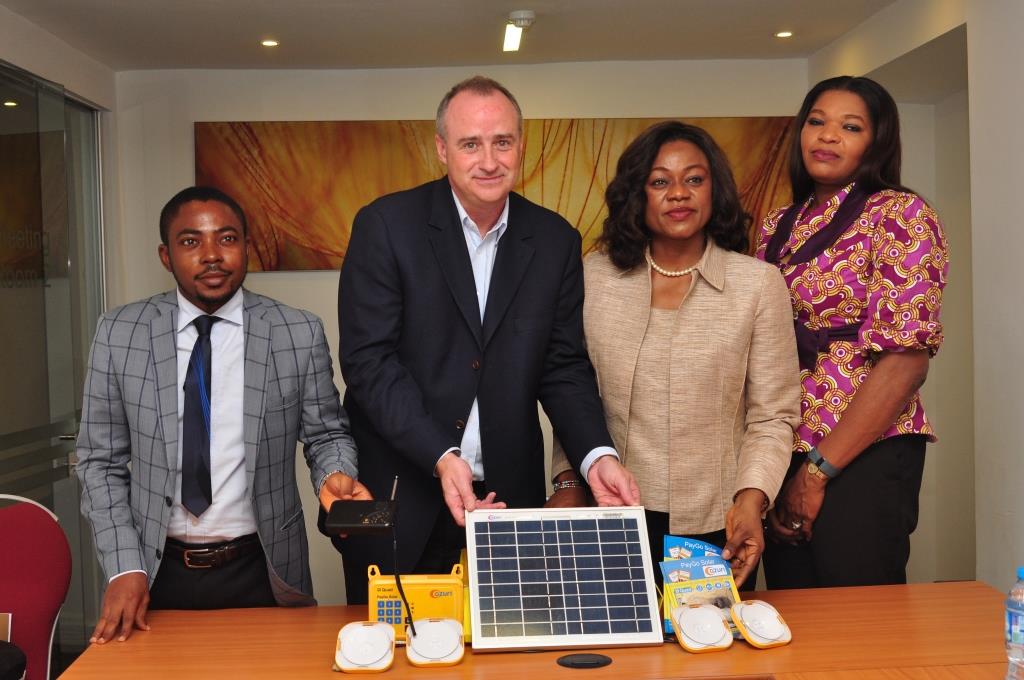
But a commercial provider of PayGo solar systems to rural off-grid communities, Azuri Technologies Limited, has made that very easy and affordable with its Azuri Quad.
At a media briefing in Lagos on Tuesday, the company’s executives disclosed that since its launch in 2016, Nigerians already enjoying its services have had sweet stories to tell to the world.
According to the General Manager of the firm in charge of the West African region, Mrs Vera Nwanze, over 300 people subscribed to its PayGo solar system in the first three weeks of the launch in Kano, adding that over 100,000 people spread across sub-Sahara Africa are already enjoying the services of the firm.
Mrs Nwanze disclosed that Azuri Technologies Ltd has the mandate to deploy 20,000 units of the system to northern part of the country within a year.
The General Manager further said that firm’s PayGo solar system has made it possible for students in rural areas of the country to study at night, excelling in schools because of this, while the system has also helped parents save money as well as reduce health hazards associated with kerosene explosions and others.
Explaining what makes Azuri Technologies different from other brands already in the market, Mrs Nwanze said the Azuri Quad is simple to install with all components provided.
She added that when properly used, the solar system can last more than 10 years, pointing out that the system has a HomeSmart intelligence technology, a unique control system which adapts its output depending on weather conditions and customers’ energy usage patterns, which is unique to the company.
In addition, the company’s Vice President of Market Development, Mr Paul Foster, who also addressed the media yesterday, disclosed that subscribers can have their battery box (Azuri Quad) changed if faulty.
He assured Nigerians that they can never regret obtaining the solar system from company because it was made of high quality and due diligence.
The PayGo system, the 10W Azuri Quad, has a lithium battery, a solar panel fixed outside and four individually powered high brightness LED lamps to illuminate the home.
It also has a USB port, with charging cable and connectors for most mobile phones, making it possible for users to stay in touch with friends and family.
In addition, the customer enjoys a payment plan spread over three years, after which the system is unlocked to use for free thereafter.
It is also important to stress that the unit comes with a transistor radio to keep users abreast with happenings around the world.
The system has full digital switching, allowing the user to control all lights and charging from the central unit.
Mrs Nwanze, who appealed to the government to put in place stable policies, disclosed that an enabling environment will help grow the renewable energy sector, which she said can be the solution to Nigeria’s power problem.
She said the Azuri Quad system, since its launch last year, has helped boost the country’s economy, which fell into recession in 2016.
Mrs Nwanze explained that this was made possible with the employment created such as agents of the firm who help in recharging accounts of customers.
She further noted that the firm regularly sensitise its customers on how to maximally use the product.
The General Manager said the company, in partnership with the Niger Delta Power Holding Company (NDPHC), will illuminate rural areas in the region.
Yesterday’s briefing, which took place in Lagos, was attended by the company’s Operations Manager, Ochai Adejoh; Vice-President of Market Development, Paul Foster; General Manager Nigeria/Ghana, Vera Nwanze; and the Business Development Manager, Lande Abudu.
Economy
Six Price Losers Handicap NASD Exchange by 0.86%
By Adedapo Adesanya
The NASD Over-the-Counter (OTC) Securities Exchange was depleted by 0.86 per cent on Friday, November 14, after the price of six securities on the platform closed lower.
This reduced the NASD Unlisted Security Index (NSI) by 31.38 points to 3,613.23 points from the 3,644.61 points recorded a day earlier, as the market capitalisation lost N18.77 billion to end the week at N2.161 trillion compared with the N2.180 trillion it finished a day earlier.
During the session, NASD Plc fell by N4.00 to close at N55.00 per share compared with the preceding session’s N59.00 per share, FrieslandCampina Wamco Plc crashed by N3.00 to end at N51.00 per unit versus the previous day’s N54.00 per unit, Central Securities Clearing System (CSCS) Plc depreciated by N1.60 to close at N40.40 per share versus N42.00 per share, Lagos Building Investment Company (LBIC) Plc went down by 35 Kobo to settle at N3.13 per unit compared with the N3.48 per unit it ended on Thursday, UBN Property Plc decreased by 26 Kobo to quote at N2.33 per share versus the preceding day’s N2.59 per share and Industrial and General Insurance (IGI) Plc crumbled by 1 Kobo to close at 41 Kobo per unit versus 42 Kobo per unit.
Yesterday, the volume of securities traded by market participants increased by 99.5 per cent to 2.2 million units from the previous day’s 119,329 units, the value of securities ballooned by 4,185.1 per cent to N82.9 million from N1.9 million, and the number of deals expanded by 50 per cent to 21 deals, from 14 deals.
When the market ended for the session, Infrastructure Credit Guarantee Company (InfraCredit) Plc remained the most traded stock by value with a year-to-date sale of 5.8 billion units valued at N16.4 billion, trailed by Okitipupa Plc with 170.3 million units traded for N8.0 billion, and Air Liquide Plc with 507.4 million units sold for N4.2 billion.
InfraCredit Plc also ended as the most traded stock by volume on a year-to-date basis with 5.8 billion units worth N16.4 billion, followed by IGI Plc with 1.2 billion units transacted for N419.7 million, and Impresit Bakolori Plc with 536.9 million units valued at N524.9 million.
Economy
Naira Slips to N1,442/$ at Official Market
By Adedapo Adesanya
The Naira weakened against the US Dollar in the Nigerian Autonomous Foreign Exchange Market (NAFEM) on Friday, November 14 on fresh forex demand pressure associated with this period.
During the session, the domestic currency depreciated against the greenback by 99 Kobo or 0.07 per cent to trade at N1,442.43/$1, in contrast to the N1,441.44/$1 it traded on Thursday.
In the same official market window, the local currency closed flat against the Pound Sterling at N1,898.96/£1, but further declined against the Euro by N3.60 to close at N1,678.56/€1 versus the previous day’s N1,674.96/€1.
However, at the GTBank FX counter, the Naira appreciated against the Dollar yesterday by N2 to settle at N1,448/$1 versus the preceding session’s rate of N1,448/$1, and in the parallel market, it maintained stability at N1,455/$1.
Increased demand for Dollars above the supply level has impacted price swing, but in the last two sessions, the pressure have been minimal.
In recent weeks, the apex bank FX injection has been minimal and erratic due to increasing FX inflows from foreign portfolio investors and exporters. FX inflow into currency market has fallen from peaked of $1.37 billion to $899 million.
While the Naira came under renewed strain, Nigeria’s foreign reserves continued their upward trajectory, climbing to $43.5 billion, up from $43.32 billion the week before.
This steady improvement in external reserves may be attributed to stronger crude oil receipts, improved non-oil inflows, and tightened FX management policies by the Central Bank of Nigeria (CBN).
As for the cryptocurrency market, investors tried to claw back some gains after many liquidated positions in the recent sessions largely driven by a lack of clarity on key US economic conditions and subsequent monetary policy direction.
That data blackout was due to the longest US government shutdown that lasted from October 1 until Thursday, that suspended government inflation and jobs data releases, with Litecoin (LTC) growing by 8.5 per cent to $104.14.
Further, Binance Coin (BNB) rose by 2.3 per cent to sell for $932.27, Solana (SOL) went up by 0.9 per cent to $142.71, Ethereum (ETH) jumped by 0.3 per cent to $3,175.02, and Dogecoin (DOGE) also appreciated by 0.3 per cent to $0.1633.
But Cardano (ADA) depreciated by 0.8 per cent to $0.5130, Ripple (XRP) fell by 0.3 per cent to $2.28, and Bitcoin (BTC) dropped 0.2 per cent to finish at $96,193.83, while the US Dollar Tether (USDT) and the US Dollar Coin (USDC) remained unchanged at $1.00 each.
Economy
Oil Market Jumps 2% as Russia Halts Export from Key Port
By Adedapo Adesanya
The oil market was up by more than 2 per cent on Friday as a key Russian port suspended oil exports after Ukraine attacked the facility, raising concerns about supply.
Brent crude futures increased by $1.38 or 2.19 per cent to trade at $64.39 a barrel and the US West Texas Intermediate (WTI) crude futures grew by $1.40 or 2.39 per cent to close at $60.09 a barrel. Brent rose 1.2 per cent on the week, and WTI posted a weekly gain of 0.6 per cent.
Russia’s port of Novorossiisk halted oil exports following a Ukrainian drone attack that hit an oil depot in the Russian energy hub, stoking supply concerns.
The port, a key export outlet of crude from Russia and Kazakhstan, and a major wheat export hub, paused oil exports, equivalent to 2.2 million barrels per day, or 2 per cent of global supply.
According to reports, the attacks damaged a ship, nearby apartment buildings, and an oil depot, injuring three crew members aboard the vessel. This comes as Ukrainian forces have increasingly targeted Russian oil-refining, storage, and export infrastructure using drones and missiles.
In addition, Russia’s pipeline company Transneft suspended crude oil supply to the facilities at the port.
Ukraine on Friday said it separately struck an oil refinery in Russia’s Saratov region and a fuel storage facility in nearby Engels overnight.
Market analysts noted that in recent month, Ukraine has made a shift in strategy from smaller-scale strikes on storage tanks to targeting hard-to-replace refinery equipment, like cracking units, much of it western-made and subject to sanctions.
Britain on Friday issued a special licence allowing businesses to continue working with two Bulgarian subsidiaries of sanctioned Russian oil firm Lukoil, as the Bulgarian government seized control of the assets.
The US imposed sanctions banning deals with Russian oil companies Lukoil and Rosneft after November 21 as part of efforts to stop the war which commenced with Russia attacking Ukraine in February 2022.
While geopolitical tensions and the end of the US government shutdown offered fleeting support this week, the market remained focused on rising global inventories, shifting supply-demand expectations from the Organisation of the Petroleum Exporting Countries (OPEC) and the International Energy Agency (IEA) and a broader sense that supply continues to outpace demand.
-
Feature/OPED6 years agoDavos was Different this year
-
Travel/Tourism9 years ago
Lagos Seals Western Lodge Hotel In Ikorodu
-
Showbiz3 years agoEstranged Lover Releases Videos of Empress Njamah Bathing
-
Banking7 years agoSort Codes of GTBank Branches in Nigeria
-
Economy2 years agoSubsidy Removal: CNG at N130 Per Litre Cheaper Than Petrol—IPMAN
-
Banking3 years agoFirst Bank Announces Planned Downtime
-
Sports3 years agoHighest Paid Nigerian Footballer – How Much Do Nigerian Footballers Earn
-
Banking3 years agoSort Codes of UBA Branches in Nigeria