Connect with us

Economy

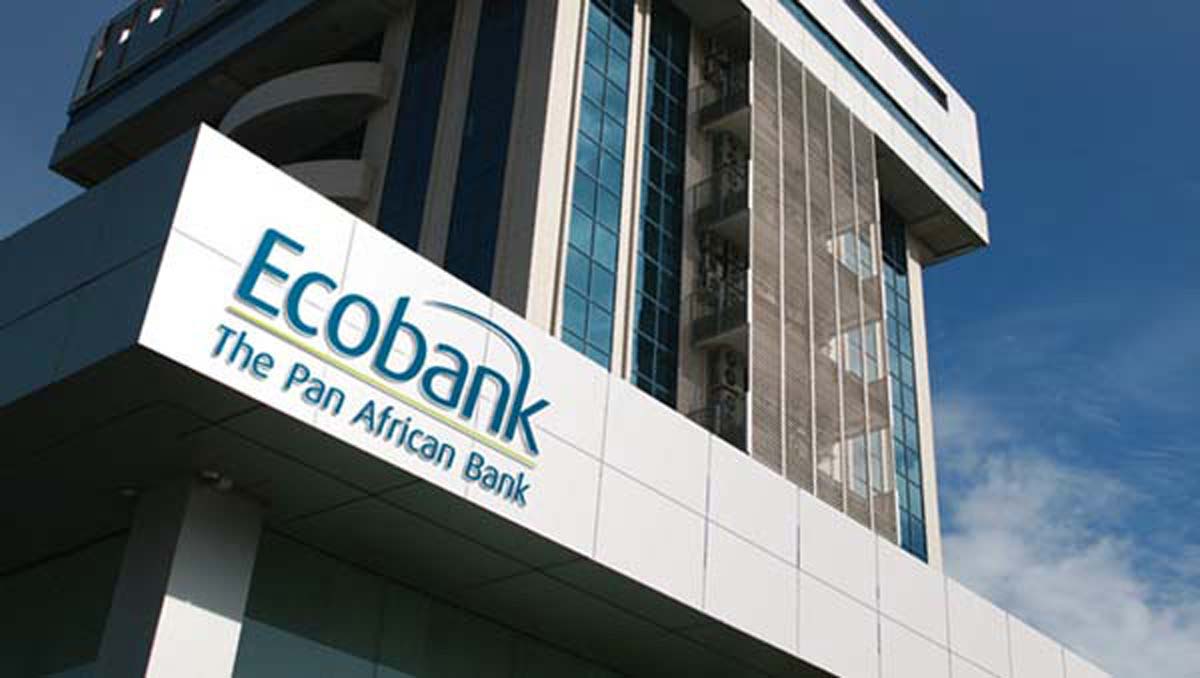
Ecobank Blames Decline in Q3 2020 Profit on Oceanic Bank

Published

on

Ecobank Nigeria

By Dipo Olowookere

Last week, Ecobank Transnational Incorporated (ETI) released its financial statements for the nine-month period ended September 30, 2020.

The financial status of the lender showed a notable decline in the profit for the period under consideration and according to the management of Ecobank, this was mainly due to the defunct Oceanic Bank, a financial institution it acquired in 2011.

Ecobank specifically said the profit was significantly impacted by the provision of N60.6 billion for goodwill for the acquisition of Oceanic Bank then led by Ms Cecelia Ibru.

A look at the financial statements of the bank by Business Post showed that in the first nine months of this year, Ecobank recorded a profit before tax and goodwill impairment of N95.1 billion in contrast to the N109.5 billion in the same period of 2019 and a profit before tax of N34.5 billion in contrast to the N109.5 billion a year earlier, while the profit after tax slumped to N10.3 billion from N78.8 billion.

However, the mid-level financial institution expressed optimism that “with the clean book aftermath of the full provisioning for Oceanic Bank, it will improve on its profitability for the year-end.”

A look at the top line of the results showed that gross earnings marginally increased in the period under review to N613.2 billion from N610.9 billion in the corresponding period of last year, with interest income growing to N397.4 billion from N372.5 billion and the interest expense dropping to N142.3 billion from N177.1 billion and the net interest income at N255.0 billion as against N195.5 billion a year ago.

During the period under review, the fee and commission income increased to N115.1 billion from N123.8 billion, while the fee and commission expense reduced to N8.8 billion from N9.9 billion, with the net trading income flat at N97.9 billion over the two comparative periods.

According to the financial statements, there was a 9 per cent decline in the non-interest revenue to N206.1 billion from N227.2 billion in 2019, while the operating income rose by 9 per cent to N461.2 billion from N422.6 billion.

The lender stated that its staff costs slightly increased to N129.7 billion from N129.0 billion last year, while the operating expenses moved up by 4 per cent to N292.4 billion from N280.5 billion.

On the balance sheet, the total assets nudged up by 9 per cent year-to-date to N9.430 trillion during the period under review as against N8.622 trillion in the full year of 2019, while the total liabilities increased to N8.722 trillion from N7.934 trillion in FY 2019.

Also, deposits from customers increased to N6.686 trillion from N5.925 trillion in December 2019, representing 13 per cent year-to-date growth, while the total equity went up by 3 per cent at N708.6 billion versus N697.7 billion.


Dipo Olowookere is a journalist based in Nigeria that has passion for reporting business news stories. At his leisure time, he watches football and supports 3SC of Ibadan. Mr Olowookere can be reached via [email protected]

Click to comment

Leave a Reply

Your email address will not be published. Required fields are marked *

Economy

Lokpobiri Hails Petroleum Reforms Amid Surge in Investments

Published

on

petroleum products

By Adedapo Adesanya

The Minister of State for Petroleum Resources (Oil), Mr Heineken Lokpobiri, has said ongoing reforms and strategic policy implementation in Nigeria’s petroleum sector are driving significant investments and strengthening the country’s position as a leading energy destination in Africa.

Mr Lokpobiri stated this at the Management Retreat of the Ministry of Petroleum Resources, where he stressed the need for improved institutional performance and accountability to sustain growth in the sector.

According to the Minister, the federal government has deliberately pursued far-reaching reforms aimed at creating a stable and investor-friendly environment capable of attracting local and foreign capital into the oil and gas industry.

“From far-reaching institutional reforms to the effective implementation of strategic policies, we have remained committed to carrying all stakeholders along, fostering a conducive environment for investments to flourish,” Mr Lokpobiri said.

“As a result, our petroleum sector has witnessed significant investments that continue to strengthen Nigeria’s position as a leading energy destination.”

The Minister noted that the gains recorded in the sector were the product of collective efforts across the Ministry and its agencies, commending staff for their dedication and professionalism.

“The Management Retreat of the Ministry of Petroleum Resources provided an important platform to reiterate that these accomplishments would not have been possible without the collective dedication, professionalism and teamwork of every staff member across the Ministry and its agencies,” he stated.

Mr Lokpobiri said the retreat, themed Driving Institutional Performance and Accountability in the Petroleum Sector for Sustainable National Development, underscored the importance of continuous improvement in service delivery and operational efficiency.

Drawing lessons from the theme, he urged officials of the Ministry and regulatory agencies to intensify efforts toward enhancing institutional effectiveness and strengthening governance frameworks.

“I encouraged that we must redouble our efforts, continuously improve the quality of our services, and strengthen institutional performance,” he said.

The Minister further emphasised the continued relevance of fossil fuels in the global energy mix, stressing that Nigeria must leverage its hydrocarbon resources to drive economic growth while ensuring citizens benefit from ongoing reforms.

“With fossil fuel as the dominant source of energy, we must ensure that Nigerians experience the benefits of our progress and that Nigeria remains the preferred investment destination in Africa and a globally competitive hub for energy investments,” Mr Lokpobiri added.

Continue Reading

Economy

Universal Insurance Extends N3.2bn Rights Issue to June 22

Published

on

Universal Insurance shares

By Aduragbemi Omiyale

The N3.2 billion rights issue of Universal Insurance Plc has been extended by almost two weeks after securing regulatory approval.

The exercise was earlier scheduled to close on June 10, 2026, but will now close on Monday, June 22, 2026.

The extension was granted by the Securities and Exchange Commission (SEC) after a request from the underwriting organisation.

In the rights issue, Universal Insurance is offering to shareholders 2,666,666,667 ordinary shares of 50 Kobo each at N1.20 per share on the basis of one new ordinary share for every existing six ordinary shares held as of the close of business on Monday, March 30, 2026.

Subscription for the acquisition of the company’s extra shares opened on Wednesday, May 13, 2026.

The extension gives investors more time to increase their stake in the insurance firm, which intends to use proceeds from the exercise to boost its capital base, as mandated by the National Insurance Commission (NAICOM).

Insurance companies operating in Nigeria have been given till July 31, 2026, to shore up their capital base or pack up. Operators can also explore a merger if they wish.

Continue Reading

Economy

4.964 billion Shares Worth N207.5bn Exchange Hands in 235,966 deals in Four Days

Published

on

nigerian shares

By Dipo Olowookere

The Nigerian Exchange (NGX) Limited opened its doors to market participants in four days last week as a result of a public holiday observed on Friday, June 12, for 2026 Democracy Day in the country.

In the week, investors bought and sold 4.964 billion shares worth N207.521 billion in 235,966 deals, as against the 3.966 billion shares valued at N175.659 billion that exchanged hands in 343,587 deals a week earlier.

Analysis showed that the financial services industry led the activity chart with 4.116 billion shares valued at N84.607 billion in 96,165 deals, contributing 82.92 per cent and 40.77 per cent to the total trading volume and value, respectively.

The services sector transacted 232.479 million shares worth N4.955 billion in 17,614 deals, while the industrial goods segment exchanged 144.988 million shares worth N39.077 billion in 24,775 deals.

Sterling Holdings, FCMB, and Access Holdings were the most traded stocks with 2.883 billion units sold for N36.188 billion in 15,533 deals, accounting for 58.09 per cent and 17.44 per cent of the total trading volume and value, respectively.

A total of 40 equities appreciated in the week versus 23 equities in the previous week, 53 equities depreciated versus 65 equities a week earlier, and 53 equities remained unchanged versus 58 equities in the preceding week.

ABC Transport was the best-performing equity for the week after it gained 25.60 per cent to trade at N7.80, Consolidated Hallmark appreciated by 23.13 per cent to N8.25, Abbey Mortgage Bank rose by 21.93 per cent to N11.40, Infinity Trust Mortgage Bank grew by 20.32 per cent to N11.25, and Austin Laz soared by 15.16 per cent to N4.33.

The worst-performing equity last week was Fidson Healthcare because of its 25.86 per cent loss, closing at N101.20. Neimeth declined by 19.14 per cent to N8.55, Union Homes REIT shed 17.36 per cent to close at N70.00, SUNU Assurances slipped by 11.38 per cent to N3.97, and Unilever Nigeria dropped 10.26 per cent to trade at N140.00.

As for the index movement, the All-Share Index (ASI) and the market capitalisation chalked up 0.88 per cent each to settle at 244,738.74 points and N156.970 trillion, respectively.

Similarly, all other indices finished higher apart from the pension, AFR Bank Value, MERI Growth, MERI Value, consumer goods, Lotus II, industrial goods, sovereign bond and commodity indices, which fell by 0.03 per cent, 1.20 per cent, 0.21 per cent, 1.61 per cent, 0.54 per cent, 0.51 per cent, 1.00 per cent, 2.04 per cent and 0.34 per cent, respectively.

Continue Reading

Trending