Connect with us

Economy

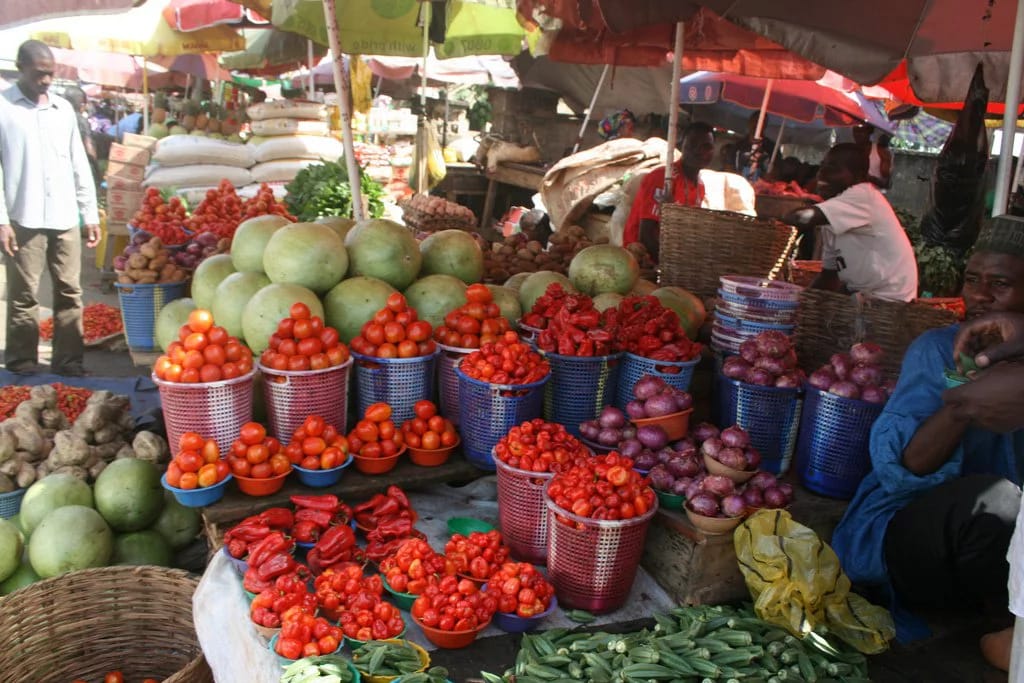
Food Prices ‘ll Remain High Except Security Gets Better—Farmer

Published

on

prices of foodstuffs

By Ahmed Rahma

Farmers in Nigeria have disclosed that the rise in the prices of food items at the market will continue to go up except the government address insecurity in the country.

The national president of All Farmers Association of Nigeria (AFAN), Mr Kabir Ibrahim, while addressing newsmen recently, noted that some of his members have abandoned their farms because of threats to their lives.

Recall that some days ago, more than 40 farmers were killed by Boko Haram sect while they were at their rice farms in Borno State for harvest.

In other parts of the country, farmers have had their crops destroyed by hoodlums and cattle rearers, causing a huge shortage of food supply to the market.

In recent times, onions have become gold in Nigeria and this has largely been due to security issues in the country, flood and the COVID-19 pandemic.

But the farmers have warned that if the security situation in the country does not improve, Nigerians may have to continue to buy food items at exorbitant prices for months.

“It is normal to have escalating prices when there is a slight shortage. The effect of COVID-19, flooding and insecurity on food production is bringing up its head and that is why we are having this concern.

“The COVID-19 pandemic is global. Even in the US, there is an article that revealed that there are currently cases of shoplifting and about 54 million people are going to be hungry,” the AFAN leader said.

“So, in Nigeria, we believe that the high food prices will be there for some months, except if security is enhanced and our people are able to do dry season farming,” he submitted.

Speaking further, Mr Ibrahim disclosed that, “The dry season farming will be to augment the raining season farming that we have done,” noting that, “Without that, we will still have soaring prices.”

The AFAN president further noted that the harsh economy would not support the purchase of farm produce by the government for storage in national silos, in case the government intended to buy agricultural commodities.

He explained that any move to make such purchase would further worsen inflation, adding that this had made the situation more precarious.


Ahmed Rahma is a journalist with great interest in arts and craft. She is also a foodie who loves new ideas. She loves to travel and would love to visit other African countries someday. She is a sucker for historical movies and afrobeat.

Click to comment

Leave a Reply

Your email address will not be published. Required fields are marked *

Economy

Nigeria Needs More Taxpayers, Not Higher Taxes—Oyedele

Published

on

FIRS taxes

By Adedapo Adesanya

The Minister of Finance and Coordinating Minister of the Economy, Mr Taiwo Oyedele, yesterday clarified that the federal government is not increasing taxes but making efforts to raise the tax net.

Mr Oyedele made this remark on Thursday while receiving a delegation from the Chartered Institute of Taxation of Nigeria (CITN) at his office in Abuja.

He hailed the institute for introducing a National Tax Awareness Day and for supporting the current tax reforms of the federal government.

The minister charged the institute to double its effort in public enlightenment, stressing that many Nigerians still view taxation as a means for the government to take money from citizens.

He reiterated that the priority of the government is not to increase tax rates but to broaden the tax base by ensuring that all eligible taxpayers meet their obligations.

“We are still not getting enough revenue from taxes.

“It is not about increasing taxes but making sure that those who are supposed to pay taxes. We want to promote fairness in tax administration,” he said.

Nigeria is challenged by the inability to generate adequate revenue from taxation despite ongoing reforms, stressing that a significant number of eligible taxpayers have yet to fulfil their civic obligations.

He said the challenge facing the country was not necessarily about raising tax rates but ensuring that individuals and businesses that ought to pay taxes do so in a fair and transparent system.

The minister also commended the institute for supporting the federal government’s tax reform agenda and promoting public understanding of taxation, but urged it to intensify its advocacy efforts, noting that many Nigerians still harbour misconceptions about taxation.

According to him, many citizens continue to view taxation merely as a tool for the government to take money from the people rather than as a critical instrument for national development.

“We are still not getting enough revenue from taxes. It is not about increasing taxes, but making sure that those who are supposed to pay taxes. We want to promote fairness in tax administration,” he added.

Mr Oyedele stressed that if Nigeria succeeds in building an efficient and equitable tax system, the impact on infrastructure, public services and economic development would be transformative, challenging the institute to introduce annual awards for the country’s most tax-compliant individuals and organisations as a means of encouraging voluntary compliance and recognising responsible taxpayers.

Continue Reading

Economy

Akara, Kulikuli, Roasted Corn Business Not Capital Intensive—Remi Tinubu

Published

on

remi tinubu

​By Modupe Gbadeyanka

Nigeria’s First Lady, Mrs Oluremi Tinubu, has given Nigerians business advice that may not involve a lot of money to start.

Speaking with newsmen recently, the wife of President Bola Tinubu said businesses like akara (fried bean cake), kulikuli (a crunchy snack from roasted peanuts or groundnuts) and roasted corn can be set up without breaking the bank.

She disclosed that to support her husband’s Renewed Hope agenda, she has provided funding packages to traders and others to the tune of N3.5 billion.

“To start akara business doesn’t take a lot of money. To start roasting corn and kuli-kuli doesn’t take much. We didn’t give them a loan; we gave it to them as a grant,” she stated.

She further said, “We’ve encouraged Nigerians as best as we could, what is within our hands, I have given, and I keep giving. Those are the things we’ve done.”

“I remember giving for TB (tuberculosis) when I heard of many TB cases; I gave N2 billion, to breast cancer, I gave N1 billion, and to [tackle] malnutrition, I gave N500 million.

“These are the things we’ve been doing to assist the government. So, we’ve had impact in agriculture, social investment, education (as scholarship and ICT training) and others. We are still open to doing more,” she disclosed.

Continue Reading

Economy

NASD Exchange Extends Winning Streak by 1.70%

Published

on

NASD OTC stock exchange

By Adedapo Adesanya

The NASD Over-the-Counter (OTC) Securities Exchange rallied by 1.70 per cent on Thursday, June 25, after three price gainers overpowered the two price losers recorded at the close of business.

Consequently, the market capitalisation of the trading platform increased by N43.79 billion to N2.618 trillion from N2.574 trillion, and the NASD Security Index (NSI) improved by 72.96 points to close at 4,362.32 points, in contrast to Wednesday’s 4,289.36 points.

Yesterday, the price advancers were led by Nipco Plc, which chalked up N31.79 to close at N349.76 per unit versus the preceding day’s N317.97 per unit. Okitipupa Plc gained N18.00 to end at N298.00 per share versus the previous session’s N280.00 per share, and Central Securities Clearing System (CSCS) Plc went up by N7.11 to N86.79 per unit from N79.68 per unit.

On the flip side, Nitrox Industrial Gases Plc crumbled by 32 Kobo to close at N21.09 per share compared with the N21.41 per share it closed at midweek, and Food Concepts Plc depreciated by 25 Kobo to N2.51 per unit from N2.76 per unit.

During the session, the value of securities traded by investors went down by 86.7 per cent to N10.9 million from the preceding session’s N82.9 million, and the volume of securities dropped 84.9 per cent to 10.9 million units from the previous 82.9 million, while the number of deals grew by 84.2 per cent to 35 deals from 19 deals.

At the close of trades, Great Nigeria Insurance (GNI) Plc remained the most traded stock by value on a year-to-date basis, with 3.4 billion units sold for N8.4 billion, trailed by Infrastructure Credit Guarantee (Infracredit) Plc with 2.3 billion units valued at N6.5 billion, and CSCS Plc with 68.4 million units exchanged for N4.7 billion.

GNI Plc was also the most traded stock by volume on a year-to-date basis, with 3.4 billion units worth N8.4 billion, followed by Infracredit Plc with 2.3 billion units traded for N6.5 billion, and Resourcery Plc with 1.1 billion units transacted for N415.7 million.

Continue Reading

Trending