Connect with us

Economy

Nigerian Exchange Surges 0.99% as Investor Sentiment Improves

Published

on

Nigerian Exchange 1

By Dipo Olowookere

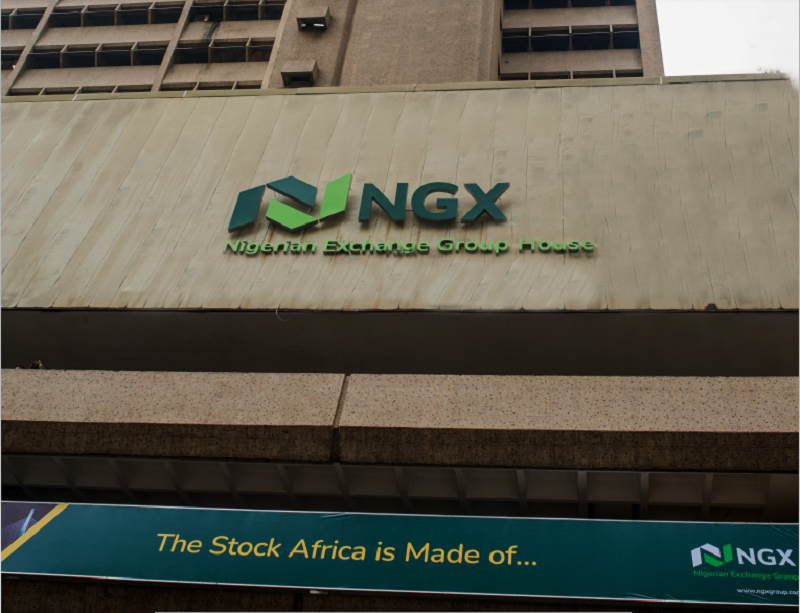
The last trading session of the week at the Nigerian Exchange (NGX) Limited ended on a positive note, with a 0.99 per cent growth on Friday inspired by an improvement in investor sentiment.

Business Post reports that the local bourse ended with 29 appreciating stocks and 22 depreciating stocks, implying a positive market breadth index.

This was buoyed by the 1.05 per cent rise in the consumer goods sector and a 0.28 per cent upsurge in the banking counter, though the insurance index declined by 1.58 per cent, and the energy and industrial goods sectors closed flat.

MTN Nigeria ended the day as the best-performing equity after its value rose by 9.99 per cent to N221.40, and Dangote Sugar expanded by 9.98 per cent to N55.65. NASCON increased by 9.97 per cent to N52.40, Ikeja Hotels jumped by 9.87 per cent to N6.68, and Deap Capital soared by 8.62 per cent to 63 Kobo.

The worst-performing stock for the session was FTN Cocoa, which declined by 9.80 per cent to trade at N1.38, C&I Leasing lost 8.66 per cent to close at N3.48, Guinness Nigeria moderated by 8.39 per cent to N42.05, Guinea Insurance went down by 7.89 per cent to 35 Kobo, and ABC Transport waned by 7.69 per cent to 72 Kobo.

Traders transacted 358.1 million shares valued at N19.9 billion in 10,786 deals on Friday versus the 554.7 million shares valued at N17.7 billion in 9,708 deals on Thursday, indicating a decline in the trading volume by 35.44 per cent, a growth in the trading value by 12.43 per cent, and an increase in the number of deals by 11.10 per cent.

Transcorp closed the day as the most active equity for selling 92.9 million units worth N1.6 billion, Transcorp Power traded 30.5 million units worth N11.7 million, UBA exchanged 26.2 million units valued at N570.2 million, Access Holdings exchanged 23.3 million units worth N465.5 million, and GTCO sold 18.0 million units for N734.5 million.

At the close of business today, the All-Share Index (ASI) surged by 995.55 points to 101,330.85 points from 100,335.30 points, and the market capitalisation gushed by N563 billion to N57.294 trillion from N56.731 trillion.


Dipo Olowookere is a journalist based in Nigeria that has passion for reporting business news stories. At his leisure time, he watches football and supports 3SC of Ibadan. Mr Olowookere can be reached via [email protected]

Click to comment

Leave a Reply

Your email address will not be published. Required fields are marked *

Economy

Extensive Distribution Network, Promotional Activities Buoy Indomie 60% Noodles Market Share

Published

on

dufil indomie

By Aduragbemi Omiyale

Dufil Prima Foods Limited, makers of the popular Indomie Noodles, has been able to control over 60 per cent of the noodles market share in Nigeria because of its strong customer base, extensive distribution network and promotional activities, GCR Ratings has said.

These strategies deployed by the organisation have improved its financial profile, prompting the rating agency to upgrade the national scale long-term and short-term issuer ratings of Dufil to A(NG)/A1(NG) from A-(NG)/A2 (NG), previously, with a stable outlook.

It was disclosed that the company has witnessed strong cash generation and modest debt levels, which have enhanced its credit profile.

GCR said Dufil’s supply chain stability and ongoing product development have helped it to sustain the brand’s appeal to the young demographics in Nigeria and deepen market penetration.

These strengths are partly offset by high revenue concentration, with noodles accounting for more than 74 per cent, while other business lines, including flour, pasta, snacks, packaging, and palm oil, contribute a combined 26 per cent in 2025, it stated.

“We expect noodles to remain a dominant contributor to topline, supported by plans to expand noodle production capacity in 2026. Nevertheless, the completion of the flour plant expansion in Q3 2026 is expected to modestly increase the contribution of the flour business and support margins in the snacks segment,” a part of the statement obtained by Business Post read.

In the 2025 fiscal year, Dufil grew its earnings by 30 per cent to N1.1 trillion as a result of inflation-induced price review and gradual volume recovery. Its absolute EBITDA contracted to N84.5 billion from N92.7 billion in 2024, while its EBITDA margin eased to 8 per cent from 11.4 per cent in 2024.

Also, gross debt reduced to N96.2 billion from N163.6 billion in 2024, and to N79.6 billion in the first quarter of 2026, driven by management efforts to deleverage its balance sheet from expensive borrowings.

In addition, the liquidity position has slightly improved on robust cash holding of N44.6 billion, including restricted cash of N20.8 billion as of March 2026, adequate to cover the anticipated short-term debt obligations of N47.9 billion over the next nine-month period to December 31, 2026.

Although refinancing risk remains high with short-term debt accounting for above 40 per cent of the total debt, liquidity is further supported by sizable, unutilised committed facilities of N106.5 billion, indicating the company’s wide access to funding sources.

GCR said it expects the anticipated higher capital spending of N32.5 billion over the next 21 months to December 2027, as well as projected higher dividend payments in view of robust prior year profits to be sufficiently covered by the projected robust operating cash flow.

Continue Reading

Economy

FG Encourages Businesses to Tap $1bn AfCFTA Financing Scheme

Published

on

AfCFTA

By Adedapo Adesanya

The federal government says Nigerian businesses now have access to a $1 billion financing facility under the African Continental Free Trade Area (AfCFTA), designed to strengthen production and improve export competitiveness across African markets.

Speaking at the 2nd Quarter 2026 meeting of the AfCFTA Central Coordination Committee in Abuja, the Minister of Industry, Trade and Investment, Mrs Jumoke Oduwole, described the financing window as a major opportunity for businesses looking to scale operations and deepen regional trade.

“This financing facility presents a significant opportunity for Nigerian companies seeking to expand operations, modernise production, and increase exports across African markets,” she said.

Mrs Oduwole noted that despite progress in AfCFTA implementation, Nigerian exporters still face challenges such as documentation bottlenecks, certification requirements, and standards compliance issues.

She said the government is addressing these gaps through trade facilitation reforms and stronger collaboration with agencies, including the Nigeria Customs Service (NCS) and the Nigerian Export Promotion Council (NEPC).

The trade minister also stressed the importance of strengthening Nigeria’s legal and regulatory framework, particularly through the domestication of the AfCFTA Digital Trade Protocol.

At the meeting, the National Coordinator and CEO of the Nigeria AfCFTA Coordination Office, Mrs Patience Okala, said the $1 billion AfCFTA Adjustment Fund Credit Facility is targeted at large-scale businesses with a minimum financing threshold of US$10 million.

“The facility will support business expansion, modernisation, working capital requirements, project development, industrialisation efforts, and regional value chain integration,” she explained.

Mrs Okala added that the coordination office is working with fund managers to ensure qualified Nigerian firms can access the facility, while also assembling a pilot group of businesses to maximise participation.

She further highlighted growing private sector engagement, noting that recent sensitisation events in Kano attracted more than 470 businesses, including women-led enterprises.

On his part, a representative of the Federal Ministry of Industry, Trade and Investment, Mr Simon Om-Ezomo, commended stakeholders for their collaboration and urged sustained commitment to policy implementation.

Continue Reading

Economy

Senate Pushes for Ban on Textile Imports

Published

on

textile park kano

By Aduragbemi Omiyale

To revive the local industry and create jobs to boost the economy, the Senate has advised the federal government to ban textile imports.

The upper chamber of the federal parliament made this suggestion on Tuesday at the plenary presided over by the Deputy Senate President, Mr Jibrin Barau.

They noted that to resuscitate textile industries in the country, the Federal Ministry of Industry, Trade and Investment, and the Federal Ministry of Agriculture should immediately implement investment-friendly policies.

The red chamber of the National Assembly recalled when Nigeria used to have a vibrant textile industry, but lamented that the influx of foreign fabrics destroyed the sector.

The Senate emphasised that to stimulate economic growth and tackle insecurity in the country, there must be a total ban on the importation of textile materials into Nigeria.

“With the lifting of the ban on textile importation in 2010, Nigeria now has almost 80 per cent of its textiles imported from China, Indonesia, Taiwan and other countries.

“This trend is definitely not helping the Nigerian economy in terms of employment generation and the conservation of foreign exchange,” Mr Katung Marshall, who co-sponsored a motion on the Urgent Need to Revive the Textile Industries in Nigeria, said on the floor of the Senate yesterday.

The Senator informed his colleagues that the government protection policies in the 1960s and 1970s, particularly the restrictions on textile imports, attracted investors and helped the sector to flourish.

According to him, during the period, Nigeria’s textile industry accommodated about 167 mills and directly employed over 500,000 people, making it the nation’s second-largest employer after the federal government.

But he said this went south in the late 1990s due to obsolete machinery, inadequate capital and persistent power supply challenges, adding that by 2007, major companies, including Kaduna Textile Limited, Arewa Textiles and United Nigerian Textiles Limited, had shut down operations, leading to the loss of over 7,000 jobs.

Continue Reading

Trending