

Connect with us

Brands/Products

Why Analyzing Media Sentiment by Frequency is Holding You Back

Published

on

Why Analyzing Media Sentiment by Frequency is Holding You Back
By Philip Odiakose

As someone who has spent over 15 years working directly with public relations measurement and intelligence and more than a decade helping brands make sense of their media performance, I can say with confidence (and a touch of media analysis fatigue) that not all PR metrics are doing what we think they are doing. And when it comes to sentiment analysis, many of us have been led by tradition, not truth. In my constant pursuit to help PR and comms professionals access metrics rooted in objectivity and research, I had to take a deeper look into how sentiment is currently being measured. After spending time digging into the methodology, analysing patterns, and comparing outcomes, it became clear: sentiment analysis by frequency has overstayed its welcome.

    “Too often, we focus on counting sentiment rather than weighing it — frequency tells us how much, but deeper analysis tells us how much it matters.”

For too long, we have boxed sentiment into just three labels — positive, negative, and neutral — and then celebrated (or panicked) based on how large each segment appears. If a brand has 60% positive sentiment, someone somewhere is already serving small chops and cutting cake. But ask the hard question: what does that 60% actually mean? Does it carry weight? Is it impactful? Is it meaningful? I recall being in a strategy session where an agency CEO saw a 60% positive sentiment report and asked, “So… should I be excited or worried?” And truthfully, the data didn’t answer that. In another situation, a client saw 35% negative sentiment and wanted to escalate to crisis mode. Again, I had to ask, what kind of negative are we talking about?

    “When it comes to sentiment analysis, it’s not enough to know the quantity of sentiment; you need to understand the intensity and quality of that sentiment. Without that, data can lead you astray.”

You see, frequency analysis doesn’t tell you intensity. It doesn’t ask, how positive is this positivity? Or how damaging is this negativity? In reality, a comment like “The brand dey try sha” (Nigerian slang for “they are doing okay”) and another saying “This brand saved my life!” are both tagged as positive but are clearly worlds apart in tone and impact. That is where the problem lies — we have focused too much on counting sentiment without weighing it.

Research provides a more meaningful approach. The empirical formula I recommend is:

    Sentiment Score (StSc) = (Number of Positive Mentions – Number of Negative Mentions) / Total Number of Mentions

This gives us a normalized sentiment index between -1 and +1, where 0 is neutral, and the extremes show very strong positivity or negativity. So if a brand has 3 positive and 2 negative mentions out of 10 total, the score becomes (3 – 2)/10 = 0.1 — slightly positive. But if it is 8 positive and 1 negative, the score is 0.7 — that is significant. Now compare that to simply saying “80% positive,” and you see why frequency alone is not enough. The difference is in the depth of interpretation. This formula still isn’t widely used across the media intelligence space, but one company that’s already ahead of the curve is Truescope (North America) — where my friend and industry expert, Todd Murphy, serves as President of North America.

    “Objective metrics that account for sentiment weight and distribution are what truly empower PR strategies. It’s not about having more positive mentions — it’s about understanding the level of positivity and negativity and its true impact on brand perception.”

 To fix this gap in analysis, we have developed the Future-Proof Sentiment Score Framework – A P+ Measurement Services Proprietary Sentiment Score Framework. This includes a more advanced Sentiment Weight Score and Distribution Matrix, which doesn’t stop at “positive/negative/neutral,” but goes further to classify sentiment into strongly, moderately, and slightly — for both positives and negatives. This matrix brings clarity to brands and communications teams. It helps you know when to celebrate, when to adjust, and when to truly raise the red flag. Starting from Q2 2025, all clients of P+ Measurement Services will have access to this upgraded sentiment analysis dashboard, alongside a dedicated dashboard that tracks the media performance of competitive CEOs. And I can say with confidence — it changes the game.

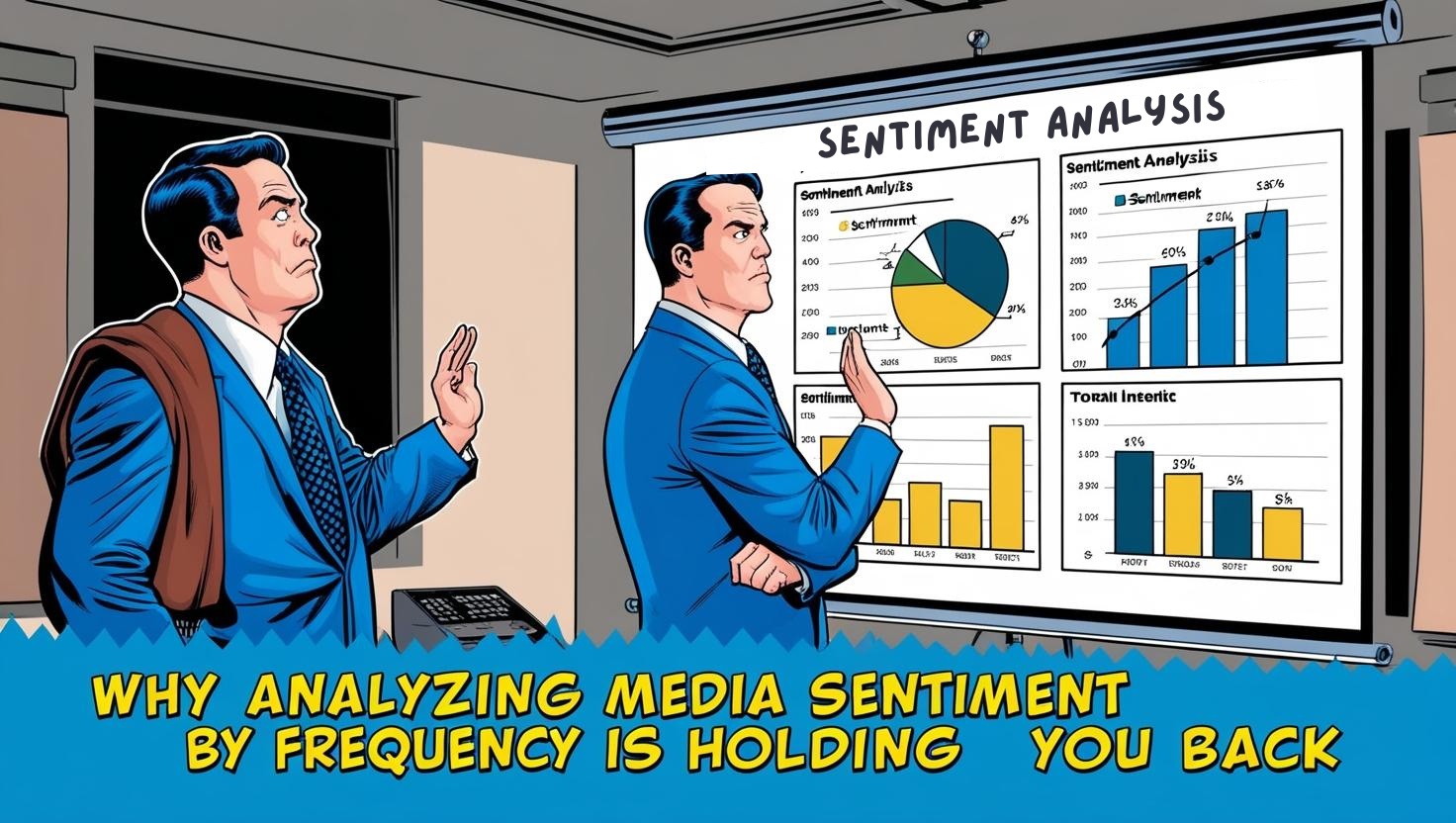
    “Let’s stop being impressed by pie charts that look shiny but don’t provide actionable insight. Understanding the meaning behind sentiment and the true impact on your brand is what matters.”

I will give you a practical example. A multinational brand we monitored recently saw 35% negative sentiment and was ready to call a crisis meeting. But our deeper analysis showed 80% of that negativity was slightly negative—things like delayed customer service or pricing feedback. Meanwhile, their strongly positive mentions were increasing daily, driven by user experience reviews. Instead of reacting emotionally, the brand realigned calmly. No panic, just action. That is the power of context.

So, let us stop being impressed by shiny pie charts. Let us stop reporting frequency without understanding what it means. A sentiment report that doesn’t answer so what? and what next? is simply not useful. This is why I always say: vanity metrics may look nice in a report, but they can’t guide strategy. Objective, research-backed metrics can.

    “Vanity metrics can’t guide strategy. Only research-backed, objective metrics help you turn insights into action.”

At the end of the day, this isn’t just about a better dashboard. It is about moving our industry forward. For those interested in the technical side, I am happy to share more about lexicon-based sentiment scoring and resources like the Harvard General Inquirer—empirical research that goes beyond assumptions and digs into real language science. But even without the jargon, the message is simple: frequency tells you how much, but only deeper analysis tells you how much it matters.

Philip Odiakose is a leader and advocate of public relations monitoring, measurement, evaluation and intelligence in Africa. He is also the Chief Media Analyst at P+ Measurement Services, a member of AMEC, NIPR, AMCRON, ACIOM and Founding Member of AMEC Lab Initiative


Brands/Products

Temu Partners Dellyman to Scale Logistics Capabilities Across Nigeria

Published

on

Dellyman Temu

By Modupe Gbadeyanka

As part of its strategies to aggressively scale its logistics capabilities across key African markets, especially in Nigeria, the fast-growing global e-commerce powerhouse, Temu, has entered into a delivery partnership with Lagos-based logistics startup, Dellyman.

Through this collaboration, Temu customers in Nigeria will experience faster, more predictable, and more transparent deliveries, a critical factor in sustaining the platform’s customer satisfaction as order volumes continue to rise.

Dellyman’s technology-driven approach, spanning rider management, route optimisation, and customer visibility, played a central role in Temu’s selection process.

In the pilot phase, Dellyman completed more than 1,300 deliveries with a 95 per cent success rate, demonstrating its readiness to support large-scale e-commerce operations nationwide.

Founded in 2020, the firm has grown into one of Nigeria’s most reliable same-day and last-mile delivery platforms.

The company recently achieved a 10,000-order monthly delivery milestone in November 2025, contributing to a cumulative total of more than 300,000 lifetime deliveries.

This track record made Dellyman a strong fit for Temu, which is aggressively scaling logistics capabilities across key African markets.

“Our partnership with Temu is a major endorsement of the vision we set out with, to build Nigeria’s most reliable, scalable, and transparent last-mile delivery infrastructure.

“Achieving a 95 per cent delivery success rate during the pilot underscores our readiness to support high-volume e-commerce platforms.

“This collaboration shows that local startups can meet and exceed global standards when given the opportunity,” the chief executive of Dellyman, Mr Dare Ojo-Bello, said.

He further noted that the partnership represents more than operational growth as it signals a shift in how global e-commerce brands view Nigerian logistics capabilities.

“This is not just about fulfilling orders; it is about reshaping perceptions of what Nigerian delivery companies can achieve. We are committed to building the kind of infrastructure that supports international standards, empowers local businesses, and ultimately strengthens consumer trust in the broader digital economy,” he noted.

Mr Ojo-Bello added that Dellyman will continue investing in capacity, fleet expansion, and merchant-facing tools to ensure superior delivery experiences for Temu buyers and other online shoppers nationwide.

Continue Reading

Brands/Products

Verve Issues Over 100 million Cards to Customers, Celebrates Milestone

Published

on

Verve 100 million Cards

By Aduragbemi Omiyale

Over 100 million cards have been issued to customers by Africa’s leading payments card brand, Verve, across the continent.

This milestone has been described as a powerful symbol of growth, resilience, and the evolving needs of millions of Africans who rely on Verve every day.

The accomplishment has been said to underscore the company’s deep consumer insight, continuous innovation, and unwavering dedication to customer satisfaction.

Verve’s evolution has consistently been inspired by the needs and aspirations of its users. Today, its acceptance footprint stretches across Africa and reaches global markets through strategic partnerships with leading brands, including Google, Netflix, Spotify, AliExpress, Temu, Flywire, YouTube Premium, and others, unlocking broader access to lifestyle, entertainment, commerce, and mobility solutions for millions of cardholders.

“What began as a simple idea, one card designed to empower everyday life, has grown into 100 million stories, 100 million touchpoints, and 100 million reasons to deepen our commitment to delivering secure, seamless, and meaningful payment experiences across Africa,” the Executive Vice President for Group Marketing and Corporate Communications at Interswitch Group, Ms Cherry Eromosele, said at a media briefing in Lagos, where she was represented by the Divisional Head for Growth Marketing (Paytoken and MVNO), Chidi Oluaoha.

Ms Eromosele further noted that the milestone is shared with the broader ecosystem; banks, processors, merchants, regulators, and partners, whose collaboration has fuelled Verve’s remarkable growth.

Most importantly, she celebrated the millions of individuals who carry Verve cards in their wallets and mobile devices, acknowledging that their trust and loyalty continue to inspire the brand’s progress.

With the 100-million-card mark now crossed, Verve is poised to accelerate its expansion efforts, elevate customer experiences, and strengthen its global acceptance network.

Continue Reading

Brands/Products

CREDICORP Launches Credit Programme for Easier Acquisition of Phones, Others

Published

on

CREDICORP Launches Credit Programme

By Adedapo Adesanya

The Nigerian Consumer Credit Corporation (CREDICORP)  has launched a national digital device credit programme that will make the acquisition of smartphones, laptops, and other essential digital tools easier for working Nigerians.

According to the scheme, which was introduced by the Nigerian government to democratise consumer credit access to Nigeria’s working population, the country’s progress is increasingly driven by access to the tools that help people learn, earn, and participate fully in a modern economy.

Over the past year, CREDICORP has supported thousands of Nigerians to acquire the assets that make daily life easier, from mobility solutions that shorten commutes and increase productivity to renewable energy systems that keep homes and small businesses powered and productive. Each intervention has shown the same outcome: when Nigerians are allowed to access essential tools through fair and responsible credit, their lives improve rapidly.

The new rollout builds on the success of the pilot phase already completed under the partnership. In the first phase, CREDICORP, working through E-Finance Company with technology support from Credlock, enabled over 1,000 Nigerians to access smartphones through affordable credit, many for the first time. The strong repayment performance and the speed of adoption demonstrated both the appetite and the national need for this kind of support.

Via this new phase, CREDICORP is poised to scale the program significantly, targeting over 15,000 Nigerians who will be able to access smartphones or laptops that directly enhance their productivity, income potential, and digital participation.

To deliver this initiative at scale, the organisation is once again working through one of its Participating Financial Institutions, E-Finance Company, with technology support from Credlock, whose intelligent device-collateral system allows for secure, responsible, and efficient access to credit. Together, E-Finance and Credlock will ensure that Nigerians can seamlessly apply for, finance, and collect the digital devices they need, without the heavy burden of upfront payments.

Speaking on the new phase, CREDICORP’s Managing Director, Mr Uzoma Nwagba, noted that this is a natural progression of the institution’s work.

“From mobility to renewable energy, we have witnessed the profound impact that access to credit can have on people’s daily lives. Nigerians are ambitious and hardworking; they simply need fair pathways to acquire the tools that move them forward. Digital devices now sit at the center of learning, earning, and productivity, and expanding access to them is a critical step in building a more digitally ready nation.”

On his part, Credlock’s CEO, Mr Dayo Fabayo, emphasized the power of turning everyday devices into pathways for progress. “Every smartphone represents potential to learn, to work, to access opportunity, and to live with dignity. At Credlock, we believe the device in someone’s hand can be the bridge to their financial future. Working with CREDICORP and E-Finance allows us to scale that vision to millions of Nigerians.”

This initiative is part of CREDICORP’s broader mission to expand consumer credit and improve the quality of life across the country. By widening access to digital tools, CREDICORP is supporting a more connected, productive, and future-ready Nigeria, one where every citizen can thrive.

Continue Reading

Trending

