Connect with us

Economy

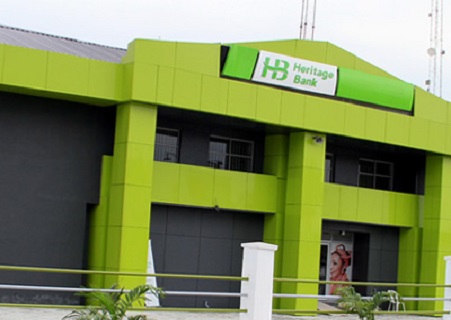
Heritage Bank Is Not In Distress—CBN

Published

on

heritage-bank-hall

By Modupe Gbadeyanka

The Central Bank of Nigeria (CBN) has come out to defend Heritage Bank following a report that the financial institution was in distress.

The apex bank, in a press statement issued on Tuesday by its Acting Director of Corporate Communications, Mr Isaac Okorafor, disclosed that the bank “is not in distress” as being speculated and urged its depositors to “go about their transactions without fear.”

CBN said it is also not true that Heritage Bank was “unable to discharge its obligations to its depositors” and insists “no Nigerian Bank is in distress.”

“The CBN, as the industry regulator, has a duty to depositors, in particular, and the economy, in general, to ensure the soundness of all financial institutions.

“We therefore wish to assure all depositors of the safety of their deposits.

“The CBN also wishes to state that it will remain alive to its responsibility of ensuring banking system stability and soundness through constant monitoring and supervision of all licensed institutions.

“The Central Bank of Nigeria wishes to reiterate that the banking system remains resilient enough to weather the current economic storm,” Mr Okorafor said in the statement.

Sahara Reporters had claimed Heritage Bank was in distress and further alleged that the CBN was only covering things up for the bank.

Though Business Post had made efforts on Tuesday to hear from Heritage Bank from its PR agency, Power Light Nigeria, but as at press time, the agency was yet to respond to our enquiry about the issues raised in the story being peddled by the online media.

Below is the controversial report by Sahara Reporters:

Heritage Bank Plc is currently stuck in a debilitating liquidity situation; SaharaReporters has learned.

Our sources disclosed on Monday that the bank is unable to meet customers’ immediate withdrawal requests and has wiped out all foreign currency domiciliary accounts through physical theft of cash by the bank’s directors.

First Bank Plc, which handles Heritage Bank’s universal clearing activities, has threatened to blacklist the bank and stop further clearing transactions if its outstanding deficit of over N5billion is not cleared.

At the weekend, at a meeting held at a secret location between the Managing Director and some top management staff, it was resolved that the Managing Director and two Executive Directors should resign their appointment for their role in throwing the institution into distress.

Sources said the bank’s operations in the Northern part of the country region are sustained by one customer, Rano Oil Limited, which maintains a deposit with Heritage Bank because its Chairman is unaware of the severity of the situation in the bank has slipped into.

Among others, the Managing Director is alleged to have been involved in the laundering of about N12.8billion. Two insurance firms: IEI Insurance Plc, and the National Insurance Commission of Nigeria, are said to be connected to the matter.

SaharaReporters gathered that the Economic and Financial Crimes Commission (EFCC) was prepared to charge the Managing Director to court, but did not, following the intervention of Senate President Bukola Saraki, who is a part-owner of the bank. The EFCC, whose chairman is awaiting confirmation by the Senate, stepped back.

Customers with foreign currency deposits are facing severe difficulties because they no longer have access to those funds.

Because of the magnitude of the bank’s problems and the possibility of prosecution, the Managing Director is said to have taken ill.

Out of about 500 Automated Teller Machines (ATMs) of the bank in the Lagos metropolis, only 138 are currently dispensing cash, the bank lacking money to feed the others.

Bank sources said a sum of N140million is required to supply all the ATM locations, and Heritage struggles to provide N10million for these ATM locations, which is why its machines rarely dispense cash.

The bank’s situation is further worsened by boardroom intrigues, tribal politics and ownership tussle.

The Managing Director and one Executive Director are said to run the bank like sole proprietors. The Managing Director and another Executive Director, Mary Akpobomen, who has been promised the position of the Deputy Managing Director by December, are in the same camp. The Yoruba interest in the bank, with Board Chairman, Mr. Seyi Akinfenwa, also has Mr. Tayo Ayeni and two Executive Directors, Mr. Niyi Adeseun and Mr. Ola Olabimjo on another side. On yet another side are Mr. Godwin Emefiele, Governor of the Central Bank of Nigeria (CBN), who is the main pusher of Delta State/Agbor interest. The battle axes are said to be two other Executive Directors, Mrs. Ada Eze and Mr. Jude.

The three-dimensional feuds have ensured that positions, postings or deployments are made on lines of group loyalty, with competence plainly ignored. The bank’s Treasurer, Mr. Abidemi Shonaiki, was eased out of the bank when the Managing Director was on leave.

Insiders revealed that the bank has been turned into a compost heap by its top management staff, who among other misdeeds, use customers’ naira deposits to finance the acquisition of private properties in Lagos, Abuja, and Port Harcourt. They are also said to award contracts at inflated costs to the Managing Director, relatives, and friends of executive directors; employ top management staff without clearance from the CBN; bribe CBN staff on banking inspection with dollars; and cover up the bank’s liquidity problems by buying cash from other banks without the required documents or due diligence.

The Heritage Bank management portfolio of misdeeds is also said to include paying N100million bribe to pension funds officials for patronage retention; illegal warehousing of N1.2billion that should be in the Treasury Savings Account; as well as illegal clearance of customers’ deposits via issuance and payments of questionable ‘PRs’ in hundreds of millions.

The CBN Governor has ensured that these misdemeanors are kept hidden due to political pressure by the owners of the bank, and because the CBN doesn’t want to give the appearance of further distress in the banking sector following the recent crisis at Skye Bank.

The bank’s ailments have also manifested in the practice of debiting customers’ accounts for transfers without crediting the beneficiaries for days, blaming it on network failure; arbitrary sacking of staff who insist on standards; sacking of staff who exposed the fraud involving the Nigeria Ports Authority through which N7billion was illegally warehoused and diverted in clear violation of TSA directives; and refusal to report fraudulent activities involving relatives and cronies of the Managing and Executive Directors.

Other symptoms of poor corporate governance include the transfer to Abuja, but not sanction, of an Executive Director and General Manager from Lagos for committing fraud; promoting Managing Director’s relatives without appraisal; fraudulent conversion of bank properties by the Managing Director and top management staff; and the procurement of N2billion worth of furniture items and N3billion Toyota cars without passing through tender procedure.

Also, the bank awarded all cleaning contracts to one Mrs. Akpobome, who used different names for contracts, which cover North, South, West, East and Abuja outlets of the bank. The Managing Director and other top management staff also award contracts to their wives and children without due diligence.

The bank, the sources added, employed school certificate holders as officers, assistant managers, deputy managers or managers, even without experience.

http://saharareporters.com/2016/11/14/distress-hits-heritage-bank-cbn-cover-mode

Modupe Gbadeyanka is a fast-rising journalist with Business Post Nigeria. Her passion for journalism is amazing. She is willing to learn more with a view to becoming one of the best pen-pushers in Nigeria. Her role models are the duo of CNN's Richard Quest and Christiane Amanpour.

Economy

N636bn BoI Loans to MSMEs Validate Economic Reform Agenda—Tinubu

Published

on

Bank of Industry BoI MSMEs

By Modupe Gbadeyanka

President Bola Tinubu has expressed satisfaction with the disbursement of N636 billion as loans to business owners in the Micro, Small and Medium Enterprises (MSMEs) in the country by the Bank of Industry (BoI) in 2025.

In a statement signed by his Special Adviser on Information and Strategy, Mr Bayo Onanuga, the Nigerian leader disclosed that the development validates his government’s economic reform agenda.

Over 7,000 enterprises were given soft loans worth N636 billion by the lender last year, the highest annual financing volume in the institution’s history.

A breakdown of the financing shows that N202 billion was allocated to agro-allied enterprises, N100 billion to critical national infrastructure, including broadband, power, aviation, and transportation, N79 billion to manufacturing, N77 billion to extractive industries, and N55 billion to services.

In addition, the bank deployed N73 billion in managed and matching funds on behalf of state governments and institutional partners.

Under the BoI 2025 disbursement, strategic interventions included upgrading a tomato processing facility from 3.1 metric tonnes per hour to 10 metric tonnes per hour and linking 47,508 smallholder farmers to formal processing value chains.

The bank also supported the deployment of 100 mini-grids in partnership with global development finance institutions, connecting 11,777 new customers to electricity. BOI-financed projects contributed to an estimated annual reduction of over 20,000 tonnes of carbon emissions.

“The N636 billion disbursed by the Bank of Industry in 2025 translates directly into productive capacity across Nigeria. It financed agro-processing expansion, strengthened manufacturing output, supported infrastructure delivery, and empowered thousands of enterprises across our states.

“At a time of global financing constraints, Nigeria expanded access to long-term capital for its businesses. That is a direct outcome of reform, credibility, and institutional discipline,” Mr Tinubu said.

It was observed that disbursement by business size reflects a deliberate inclusion strategy. Nano enterprises received N51 billion. Micro businesses accessed N32 billion. Small and medium enterprises received N178 billion in financing, while large enterprises accounted for N375 billion.

Under the federal government’s N200 billion MSMEs intervention programme, BoI recorded over 95 per cent performance as the disbursing institution. The Presidential Conditional Grant Scheme reached 957,400 beneficiaries in 2025 alone.

In addition, BOI’s financing activities led to the creation and retention of approximately 1.6 million jobs. The bank supported more than 7,000 MSMEs and 570 startups during the year.

Inclusive financing initiatives also recorded a measurable impact. Through the Guaranteed Loans for Women Programme, a N10 billion gender-focused facility providing up to N50 million per beneficiary, women-owned enterprises expanded access to affordable credit. Youth-owned enterprises received N12 billion in financing. Under the Rural Area Programme on Investment for Development, 880 rural-based enterprises across the 36 states and the FCT accessed over N6.5 billion.

The President further noted that BOI maintained strong asset quality, recording a non-performing loan ratio below 1.5 per cent despite macroeconomic headwinds. He also acknowledged the €2 billion syndicated facility secured in 2024 and the additional €210 million mobilised from international partners in 2025, which strengthened the Bank’s lending capacity.

“Development finance must be disciplined, measurable, and aligned with national priorities. What we are witnessing is the transition from strategy to scale.

“Our economic transformation will be built on production, value addition, and enterprise growth. We will continue to crowd in capital, deepen institutional reform, and ensure that access to finance supports real sector expansion across Nigeria,” President Tinubu stated.

He reaffirmed his administration’s resolve to consolidate reform gains and expand credit access to enterprises as part of a long-term strategy to accelerate industrialisation and inclusive economic growth.

Continue Reading

Economy

Six Securities Inspire NASD Exchange’s 2.13% Gain

Published

on

NASD securities exchange

By Adedapo Adesanya

Six equities buoyed the NASD Over-the-Counter (OTC) Securities Exchange by 2.13 per cent on Thursday, February 12, as the market capitalisation added N49.12 billion to end at N2.357 trillion compared with the previous day’s N2.308 trillion.

In the same vein, the NASD Unlisted Security Index (NSI) went up by 82.09 points during the session to settle at 3,940.90 points versus Wednesday’s closing value of 3,858.81 points.

Okitipupa Plc improved its value by N22.00 yesterday to N242.00 per share from N220.00 per share, Central Securities Clearing System (CSCS) Plc grew by N6.55 to N77.08 per unit from N70.53 per unit, NASD Plc rose by N4.62 to N50.88 per share from N46.26 per share, Food Concepts Plc appreciated by 29 Kobo to N3.20 per unit from N2.91 per unit, IPWA Plc advanced by 28 Kobo to N3.13 per share from N2.85 per share, and UBN Property Plc rose 1 Kobo to sell at N2.20 per unit compared with the preceding session’s N2.19 per unit.

Conversely, FrieslandCampina Wamco Nigeria Plc went down by N1.57 to N68.10 per share from N69.67 per share, and Geo-Fluids Plc depreciated by 39 Kobo to N3.63 per unit from N4.02 per unit.

As for the activity chart, the volume of trades declined by 99.2 to 8.6 million units from 1.06 billion units, the value of transactions shrank by 88.4 per cent to N53.9 million from N465.7 million, and the number of deals decreased by 25 per cent to 42 deals from 56 deals.

CSCS Plc remained the most active stock by value (year-to-date) with 18.2 million units valued at N790.9 million, trailed by Resourcery Plc with 1.05 billion units traded at N408.6 million, and Geo-Fluids Plc with 29.5 million units sold for N150.9 million.

Resourcery Plc closed the session as the most traded stock by volume (year-to-date) with 1.05 billion units worth N408.6 million, followed by Geo-Fluids Plc with 29.5 million units exchanged for N150.9 million, and Mass Telecom Innovation Plc with 20.1 million units transacted for N8.1 million.

Continue Reading

Economy

All-Share Index Rallies 0.25% as Seplat, Others Lead Gainers’ Chart

Published

on

NGX All-Share Index

By Dipo Olowookere

The Nigerian Exchange (NGX) Limited almost succumbed to profit-taking on Thursday, but for Seplat, which pulled its string to salvage the situation.

Seplat triggered a buying interest in its shares after informing the investing public of its intention to release its full-year results for 2025 on February 26, 2026.

It almost singlehandedly lifted the energy index by 4.64 per cent yesterday. This sector was the only one of the five with green at the close of business.

The others were in red, with the insurance space down by 1.47 per cent, the industrial goods segment went down by 1.09 per cent, the banking index closed lower by 0.13 per cent, and the consumer goods sector shrank 0.04 per cent.

Analysis showed that the All-Share Index (ASI) soared on Thursday by 441.28 points to 178,625.63 points from 178,184.35 points, and the market capitalisation grew by N283 billion to N114.660 trillion from N114.377 trillion.

Business Post reports that 46 equities were in green during the session and 35 equities ended in red, implying a positive market breadth index and bullish investor sentiment.

The trio of Deap Capital, RT Briscoe, and Seplat gained 10.00 per cent each to settle at N8.69, N15.84, and N8,107.00 apiece, while Zichis rose by 9.97 per cent to N9.82, with ABC Transport surging by 9.91 per cent to N7.43.

On the flip side, NAHCO lost 9.98 per cent to trade at N148.45, Abbey Mortgage Bank depressed by 9.68 per cent to N11.20, Eterna gave up 9.50 per cent to close at N30.00, May and Baker depreciated by 9.19 per cent to N40.50, and Ecobank weakened by 8.72 per cent to N45.00.

Access Holdings was the most active stock yesterday with 52.1 million units sold for N1.3 billion, Zenith Bank exchanged 42.5 million units worth N3.3 billion, Tantalizers transacted 42.1 million units valued at N253.9 million, GTCO traded 40.8 million units worth N4.3 billion, and Deap Capital transacted 34.4 million units valued at N298.1 million.

When the closing gong was struck by 2:30 pm to signify the end of trading activity, investors had bought and sold 698.3 million shares worth N28.4 billion in 50,886 deals compared with 939.2 million shares valued at N34.0 billion exchanged in 61,279 deals a day earlier.

This showed that yesterday, the trading volume, value, and number of deals decreased by 25.65 per cent, 16.47 per cent, and 16.96 per cent, respectively.

Continue Reading

Trending