Economy
VAIDS: Tax Payment Drives Accountability—Adeosun

By Modupe Gbadeyanka
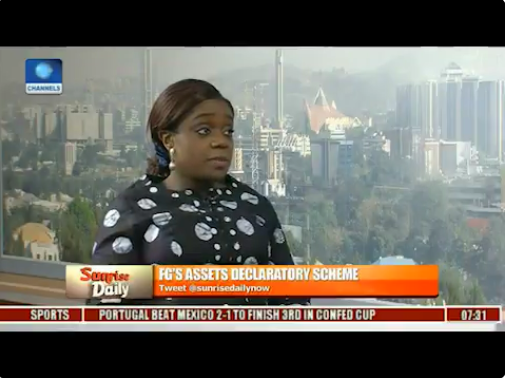
Minister of Finance, Mrs Kemi Adeosun, has disclosed that payment of tax by citizens will strengthen government’s accountability, especially at the state level.
Mrs Adeosun made this disclosure yesterday while on Channels TV to speak on the recently launched tax evasion amnesty programme of the Federal Government tagged the Voluntary Assets and Income Declaration Scheme (VAIDS), which commenced on July 1, 2017.
The Minister said it was natural for citizens to avoid paying taxes to the government, but stressed that when they eventually do, they ask questions on how their taxes are being utilised, which she said would keep the government on its toes.
She also said government usually map out punishment for tax defaulters because everywhere in the world, nobody likes to pay taxes.
“No one like paying taxes anywhere in the world, if there are no consequences for not paying taxes, people will not pay because nobody likes to,” the Minister said on Channels TV’s Sunrise Daily programme.
In the clips shared on her official Twitter page, which were viewed by Business Post, Mrs Adeosun said, “I think there is an argument that has been going on in Nigeria for many years and it is a very convenient one.
“People always ask ‘what is the government doing (with the already paid taxes) and because government is not providing (the necessary basis amenities to) me, I am not going to pay taxes’.
“Our position on this is if you look at successful nations, they have high rate of tax compliant and Nigeria intends to join that group. So, this administration is determined to change that mentality.”
The Minister further said, “Personal Income Tax is going to the state government and increasing those paying the tax will increase the physical health of the state governments.”
“This is part of our drive to reduce our reliance on oil. Many countries don’t have natural resources, but they rely on their taxes.
“We need to rebuild and enhance our tax system and I think it would help accountability because when people start paying taxes, they will take more interest in holding government to account; getting involved in budgeting and others because their money is involved rather than money shared from Abuja,” she said.
The newly launched VAIDS is expected to capture about 4 million new taxpayers from the 36 states and the Federal Capital Territory.
The scheme is to be implemented by the Federal Government in partnership with state governments and it is expected to lapse till March 31, 2018.
Government said it is targeting about $1 billion from the scheme, which aims to give tax payers a time-limited opportunity to regularise their tax status without penalty.
“Proceeds of this scheme will not disappear. We will provide regular updates on the funds collected to date, and how those funds are being put to very transparent use,” Mrs Adeosun had assured in a statement issued by her Ministry before the programme was launched on Thursday, June 29, 2017.
Economy
Crude Oil Slips to $88 Per Barrel as Iran Reopens Strait of Hormuz
By Dipo Olowookere
The price of crude oil on the global market dropped below the $90 per barrel mark on Friday after Iran announced the reopening of the Strait of Hormuz.
About 20 per cent of the world’s total oil and liquefied natural gas (LNG) consumption passes through this narrow body of water between Iran and Oman.
It was shut down by Iran after the United States and Israel launched airstrikes on it in late February 2026.
For the past few days, there have been talks between the US and Iran over the reopening of the Strait. The Middle East country reopened it after Israel and Lebanon struck a deal.
This action crashed the price of crude oil today, with the Brent grade selling at about $88 per barrel and the West Texas Intermediate (WTI) grade trading at $83 per barrel as of the time of filing this report.
Iranian Foreign Minister, Mr Abbas Araghchi, announced the reopening of the Strait of Hormuz, with the move already welcomed by President Donald Trump of the United States.
It will remain open during the ceasefire while further negotiations continue between America and Iran.
“In line with the ceasefire in Lebanon, the passage for all commercial vessels through the Strait of Hormuz is declared completely open for the remaining period of the ceasefire, on the coordinated route as already announced by Ports and Maritime Organisation of the Islamic Republic of Iran,” the Minister posted on X, formerly Twitter, on Friday.
This news will surely excite Nigerians, who have been forced to pay more to buy petroleum products since the war started, despite living in an oil-producing country.
The price of petrol jumped from about N827 per litre before the war to N1,250 and almost N1,300 per litre because of the Middle East crisis.
Dangote Refinery, which majorly supplies the local market, claimed it was buying crude oil at an international price.
Economy
Tinubu Signs N68.32trn 2026 Budget into Law, Extends Implementation Period
By Adedapo Adesanya
President Bola Tinubu has signed the 2026 Appropriation Bill into law, authorising an aggregate expenditure of N68.32 trillion for the current fiscal year.
He also signed a separate bill extending the implementation period of the 2025 budget from March 31 to June 30, 2026.
The budget allocates N4.799 trillion for statutory transfers and N15.8 trillion for debt service.
It further sets aside N15.4 trillion for recurrent expenditure and N32.2 trillion for capital expenditure through the Development Fund.
In a statement signed by Special Adviser to the President on Information and Strategy, Mr Bayo Onanuga, on Friday, it was that, “The N68.32 trillion budget for this year earmarks N4.799 trillion for statutory transfers and N15.8 trillion for debt service. It allocates N15.4 trillion to recurrent expenditure and N32.2 trillion to the Development Fund for Capital Expenditure.”
“With capital expenditure accounting for about 50 per cent, the 2026 budget underscores the administration’s continued commitment to economic stability, national security, infrastructure development, and inclusive growth.
“The allocations reflect a strategic balance between statutory obligations, debt servicing, recurrent expenditure, and capital investments critical to driving productivity and improving the quality of life for Nigerians,” it added.
The 2026 Appropriation Act took effect on April 1, with the federal government commencing full implementation in line with what the presidency describes as the Renewed Hope Agenda.
President Tinubu also assented to the Appropriation (Repeal and Enactment) (Amendment) Bill, 2026, which extends the capital component of the 2025 Appropriation Act by three months to June 30.
The presidency said the extension would ensure the full utilisation of appropriated funds, particularly for critical infrastructure projects at advanced stages of implementation.
“The extension will ensure the full and effective utilisation of appropriated funds, particularly for critical infrastructure and development projects that are at advanced stages of implementation across the country.
“It will enable Ministries, Departments, and Agencies (MDAs) to consolidate ongoing works, enhance project completion rates, and maximise value for public expenditure,” the statement read.
He directed MDAs to ensure disciplined, transparent, and efficient utilisation of allocated resources, with strong emphasis on value for money and timely project delivery.
The President reaffirmed the importance of sustained collaboration between the Executive and Legislative arms of government in advancing national development objectives, the statement noted.
President Tinubu also assured Nigerians of his administration’s resolve to deepen fiscal reforms and boost revenue generation.
Economy
Decades-Long Ogoni Shutdown Costs Nigeria $226bn in Oil Revenue—PINL
By Adedapo Adesanya
Pipeline Infrastructure Nigeria Limited (PINL) says Nigeria has lost an estimated $226.734 billion in revenue from stalled crude oil production in Ogoniland over the past 32 years.
The group at the company’s monthly stakeholders’ meeting in Port Harcourt called for an urgent, structured restart of operations in the region.
PINL described the resumption of oil production in Ogoniland as a “strategic national priority,” stressing that the process must be driven by host communities and grounded in environmental sustainability.
Speaking at the event, Mr Akpos Mezeh, General Manager, Community and Stakeholder Relations at PINL, said the scale of losses highlights both the cost of inaction and the opportunity ahead.
“Available data shows that over $226.734 billion has been lost due to the suspension of crude oil production from 96 oil wells in Ogoniland over the past 32 years. This clearly underscores both the economic cost of inaction and the immense opportunity that lies ahead,” he said.
Ogoniland, covered under Oil Mining Lease (OML) 11, has the capacity to produce over 500,000 barrels of crude oil per day. Production was halted in 1993 following unrest and environmental concerns linked to oil exploration activities.
PINL outlined key conditions for restarting operations, including active community participation, sustained environmental remediation, adoption of community-based security models, and prioritisation of economic inclusion.
“The position of PINL aligns with growing calls from stakeholders in the Niger Delta for the Federal Government to restart oil production in Ogoniland in a manner that balances economic benefits with environmental justice and community interests,” Mr Mezeh added.
He further affirmed the company’s readiness to support the process, stating: “At PINL, we stand ready to support this process by applying our experience in stakeholder engagement and infrastructure protection to ensure a peaceful, secure, and sustainable resumption.”
PINL maintained that with the right framework, resuming production in Ogoniland could significantly boost Nigeria’s crude output, increase government revenues, and support broader economic growth.
-
Feature/OPED6 years agoDavos was Different this year
-
Travel/Tourism10 years ago
Lagos Seals Western Lodge Hotel In Ikorodu
-
Showbiz3 years agoEstranged Lover Releases Videos of Empress Njamah Bathing
-
Banking8 years agoSort Codes of GTBank Branches in Nigeria
-
Economy3 years agoSubsidy Removal: CNG at N130 Per Litre Cheaper Than Petrol—IPMAN
-
Banking3 years agoSort Codes of UBA Branches in Nigeria
-
Banking3 years agoFirst Bank Announces Planned Downtime
-
Sports3 years agoHighest Paid Nigerian Footballer – How Much Do Nigerian Footballers Earn