General
Minimum Wage: NLC Calls for Nationwide Strike
By Adedapo Adesanya
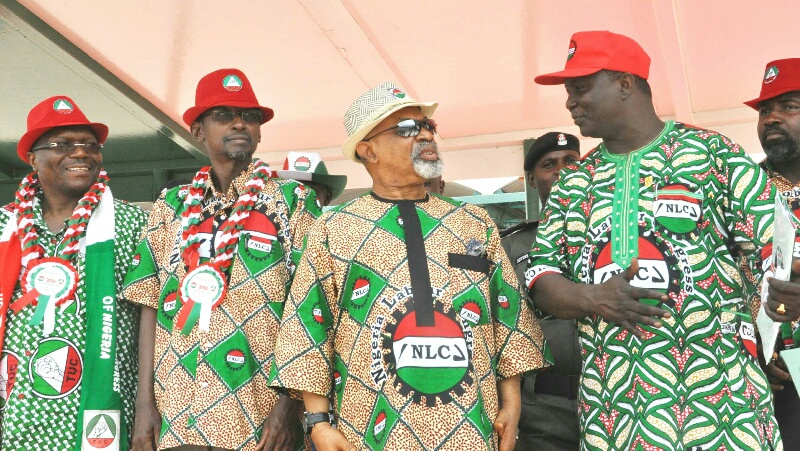
The Nigeria Labour Congress (NLC) has instructed its members to prepare for a nationwide strike on October 16 following its failure to reach an agreement with the Nigerian government.
The federal government and the organised labour failed to reach an agreement over relativity and consequential adjustments for the implementation of the new N30,000 minimum wage more than six months after it was signed into law in April.
The workforce body is demanding a 29 percent salary increase for officers on salary level 07 to 14 and 24 percent adjustment for officers on salary grade level 15 to 17.
The government on its part, proposed an 11 percent salary increase for officers on grade level 07 to 14 and 6.5 percent adjustment for workers of grade level 15 to 17.
But in a circular dispatched to its state councils and signed by the General Secretary of the NLC, Emmanuel Ugboaja, the body said the preparation to down tools was in case the proposed negotiations between it and the government slated for October 15 yields no fruit.
“You will recall that a joint Communiqué was issued by the NLC, Trade Union Congress (TUC) and the Joint National Public Service Negotiating Committee (JNPSNC) stating that two weeks from the date of the said communiqué, industrial harmony could not be guaranteed in the country should an agreement not be reached with the Federal Government on the Consequential Adjustment of Salaries as a result of the New National Minimum Wage of N30,000,” the circular said.
“You are hereby directed to coordinate preparations with TUC and JNPSNC in your States for necessary industrial action should the time expire without an agreement as contained in the circular,” it added.
However, in an interview with journalists in Lagos on Sunday, the Ekiti State governor, Mr Kayode Fayemi said that any strike by workers would be an exercise in futility.
Fayemi, who is also the chairman of the Nigeria Governors Forum (NGF) made an appeal to the workers to take into consideration the country’s economic situation before embarking on industrial action.
He said, “We don’t want workers to down tools, but we made it clear during the tripartite negotiation that an increase in the National Minimum Wage is not tantamount to a general wage review.
“The fact that we moved people, who were below N30,000 to N30,000 and wherever they should be on the scale, should not automatically mean that we must increase the salaries of people on Level 17, who are on N400,000. It is a minimum wage law; it is not a general wage law.
“Yes, if you promote levels 05 or 06, they may go over what the current level 07 is earning. So, that calls for a consequential adjustment, but that adjustment should not go over levels 08 and 09.
“The Federal Government has even agreed to do nine per cent for levels 07 to 12 and five per cent for levels 13 and above, but they said no and insisted on 45 per cent.
“Where is Nigeria going to find the money? I mean the economy is in doldrums. Whether we openly admit or not, everyone knows. If you have an economy that earmarks N2.4 trillion for debt servicing, then what are we talking about?
“So, I hope good sense will prevail and that people will be able to convince labour that it is a futile effort if they do so because Nigeria cannot pay what it doesn’t have.” He added.
General
Court Orders SERAP to Pay DSS Operatives N100m For Defamation
By Adedapo Adesanya
Justice Halilu Yusuf of the Federal Capital Territory High Court, Abuja, has awarded N100 million in damages against the Incorporated Trustees of the Socio-Economic Rights and Accountability Project (SERAP).
In his judgment, Justice Yusuf held that two operatives of the Department of State Services (DSS) were right to institute a defamation suit against SERAP.
In the suit, filed in the names of the two DSS officials, Ms Sarah John and Mr Gabriel Ogundele, the claimants accused SERAP of making a false allegation that they invaded its office in Abuja on September 9, 2024.
The court also ordered the organisation to tender a public apology to the two operatives, to be published in two national newspapers and broadcast on two television stations.
In addition, the court awarded N1 million against SERAP as the cost of litigation.
The judgment further stipulated a 10 per cent interest on the damages until the sum is fully paid.
The case follows a dispute that began in September 2024 when SERAP alleged that DSS officers “unlawfully invaded” its Abuja office.
In a post on its X account, the group said, “Officers from Nigeria’s State Security Service are presently unlawfully occupying SERAP’s office in Abuja, asking to see our directors.”
It added, “President Bola Tinubu must immediately direct the SSS to end the harassment, intimidation, and attack on the rights of Nigerians.”
The DSS, however, denied the claims.
It said the visit by its officers was routine and meant to engage the organisation’s new leadership.
The officers later sued, insisting that “no invasion occurred” and that the claims damaged their reputation and led to disciplinary action.
However, SERAP maintained its position.
In a later statement, it said, “We stand by our statements of defence and statements on oath,” insisting that DSS officers “unlawfully invaded our Abuja office.”
During court proceedings, witnesses reportedly said no physical assault took place.
SERAP’s Deputy Director, Mr Kolawole Oluwadare, told the court the claims were based on information from a staff member.
Counsel to the DSS officers, Mr Oluwagbemileke Kehinde, urged the court to grant all reliefs, arguing that the claimants had “substantially proved their case.”
General
UK Court Freezes Nigerian Oil Trader’s Global Assets Over $40m Debt
By Adedapo Adesanya
A court in the United Kingdom has taken sweeping action against a Nigerian oil trader, Mr Abdulrahman Musa Bashar, freezing his assets worldwide in a bid to secure repayment of a long-running debt dispute tied to failed fuel transactions.
The order, issued by the High Court in London, prevents Mr Bashar and his firm, Ultimate Oil and Gas FZCO, from selling, transferring, or otherwise dealing with assets across multiple jurisdictions, including Nigeria, the United Arab Emirates, the United Kingdom, and France. The restriction applies up to the value of the outstanding liability, with disclosed holdings estimated at nearly $170 million.
According to Business Day, the dispute traces back to oil trading agreements between 2022 and 2023, when Dubai-based Petrichor Energy supplied gasoil and Jet-A1 aviation fuel to Ultimate.
Court filings indicate that while deliveries were completed, payments were inconsistent and ultimately fell short, leaving the supplier to pursue legal and arbitration routes to recover its funds.
In an attempt to resolve the matter, Mr Bashar entered a personal repayment agreement in early 2024, backing the company’s obligations with his own guarantee.
He also issued a series of signed cheques as security. However, these measures failed to yield results, as the debt remained unsettled and the cheques were rejected upon presentation.
The court’s decision to impose a global freeze was influenced by what it described as troubling conduct during the dispute. Evidence suggested that assets were being sold without proceeds going toward the debt, alongside concerns that not all holdings had been fully disclosed.
The newspaper reported that testimony also pointed to an alleged warning from Mr Bashar that he might move assets out of reach if negotiations broke down, an assertion the court treated as a credible risk of asset dissipation.
The ruling adds to a growing list of legal challenges facing the businessman. He has previously been sanctioned by English courts for failing to comply with orders in a separate commercial dispute, and was also convicted in Dubai, the UAE, in a different cheque-related case.
With the freezing order now active, Petrichor has expanded its recovery efforts beyond the UK, initiating enforcement actions in both the UAE and Nigeria.
The move aims to block any pathways through which assets could be shielded, while also enabling seizure or control where legally permitted.
In a further escalation, the English court has directed two Nigerian-linked companies associated with Mr Bashar to grant access to a Delta State storage facility, allowing the creditor to recover fuel cargoes tied to the unpaid transactions. Failure to comply could trigger additional legal consequences, including contempt proceedings.
Despite ongoing attempts by Mr Bashar and his company to overturn the freezing order, the court has so far declined to lift the restrictions, leaving the enforcement process firmly in motion.
General
IFC, Norfund Back Nigeria’s Mini-Grid Expansion with $83.2m Funding
By Adedapo Adesanya
The World Bank’s financing arm, the International Finance Corporation (IFC), and the Norwegian investment fund (Norfund) have committed up to $83.2 million to expand solar hybrid mini-grids across Nigeria, in a move expected to connect nearly half a million new users to electricity.
The funding will support five renewable energy companies, Darway Coast Nigeria Limited, GVE Projects Limited, Prado Power Limited, PriVida Power Limited and StarTimes Energy, to build 315 mini-grid sites across underserved communities.
The projects are projected to deliver about 494,189 new electricity connections. Renewable energy solutions
IFC says the intervention is aimed at closing Nigeria’s massive electricity gap, noting that more than 85 million people in the country still live without access to power.
The institution said expanding distributed renewable energy will not only improve electricity access but also cut energy costs and support small businesses in rural areas.
According to IFC, “By supporting distributed renewable energy solutions, this initiative will help expand access to reliable electricity while reducing energy costs, strengthening local economies, and enabling income-generating activities.”
For operators already working in the sector, the new funding is expected to speed up expansion plans.
The chief executive of Darway Coast Nigeria Limited, Mr Henry Ureh, said the support will allow companies to scale faster and reach more communities that have remained off the national grid for years.
“Access to reliable electricity allows us to expand our operations, support local businesses, and create jobs in the communities we serve,” he said.
Nigeria’s off-grid power space has been growing steadily, but access remains uneven. Data from the Africa Solar Industry Association shows that the country currently has over 4.8 gigawatts of installed solar capacity, but only about 115 megawatts come from mini-grids serving rural communities.
The IFC has been one of the biggest institutional backers of this segment. Last year, it announced a separate $16 million financing package for Nigerian developer Virtuitis to build 97 mini-grids expected to serve over 140,000 off-grid consumers by 2027, showing a steady increase in international interest in decentralised power solutions.
With grid supply still unreliable in many parts of the country, mini-grids are increasingly becoming the most practical solution for rural electrification as they supply adequate but limited power for limited power consumption.
For many communities, the impact goes beyond electricity. Reliable power is expected to support trading activities, agro-processing, small manufacturing and education, all of which have struggled under years of unstable supply. But operators also warn that sustained policy support and stable regulation will be key to scaling beyond pilot-level projects.
As deployment begins across the 315 sites, observers are keen on understanding how quickly these projects can move from funding to actual connections to where they are needed.
-
Feature/OPED6 years agoDavos was Different this year
-
Travel/Tourism10 years ago
Lagos Seals Western Lodge Hotel In Ikorodu
-
Showbiz3 years agoEstranged Lover Releases Videos of Empress Njamah Bathing
-
Banking8 years agoSort Codes of GTBank Branches in Nigeria
-
Economy3 years agoSubsidy Removal: CNG at N130 Per Litre Cheaper Than Petrol—IPMAN
-
Banking3 years agoSort Codes of UBA Branches in Nigeria
-
Banking3 years agoFirst Bank Announces Planned Downtime
-
Sports3 years agoHighest Paid Nigerian Footballer – How Much Do Nigerian Footballers Earn